Maine Deer Herd Size
It's a question every deer hunter in Maine asks, whether they're new to the woods or have decades of experience: Just how many deer are out there? That feeling of uncertainty, of wondering if you're hunting a robust herd or a struggling one, can really mess with your head. This guide is all about peeling back the curtain on Maine's white-tailed deer population, helping you understand how biologists estimate herd size, where the deer tend to concentrate, and what all this means for your time afield.
The Complexities of Estimating Maine's White-Tailed Deer Herd
Let's be honest, trying to count every single white-tailed deer in a state as vast and wild as Maine is a monumental, if not impossible, task. We're not talking about a fenced-in preserve; this is millions of acres of dense forest, sprawling farmlands, and rugged coastline. So, when we talk about the "Maine deer herd size," we're really talking about a carefully constructed estimate, pieced together from various data points by the dedicated folks at the Maine Department of Inland Fisheries & Wildlife (MDIFW).
One of the biggest challenges is simply the sheer scale of the landscape. Northern Maine alone is a vast, wild expanse, and getting accurate counts there is a different ballgame compared to the more fragmented, developed areas of southern Maine. This means biologists rely on a blend of direct and indirect methods to build a comprehensive picture. They're looking for trends, not necessarily an exact headcount on any given Tuesday morning.
Hunters often feel a disconnect between what they see in their particular hunting spot and the statewide or WMD (Wildlife Management District) estimates. You might hunt an area where you see deer constantly and wonder why the numbers aren't higher, or conversely, hunt a sparse area and question if there are any deer at all. This discrepancy is natural; deer populations are highly localized, influenced by specific habitat, food sources, and pressure. What’s true for a specific cedar swamp in one WMD might not be true for an oak ridge miles away. Understanding how Maine Counts Its Deer Herd involves appreciating these nuances.
Biologists use a mix of sophisticated techniques to arrive at their estimates. This includes detailed harvest data from mandatory deer registrations, which provides crucial insights into the age structure, sex ratios, and overall health of the herd. They also conduct aerial surveys in certain areas, particularly deer wintering yards, to get a visual count in concentrated areas. Beyond that, there's valuable information gathered from winter tick surveys, track counts after fresh snow, trail camera data from cooperative landowners and hunters, and even citizen science reports. It's a massive puzzle with many pieces, and each piece helps refine the overall picture of the Maine Deer Population Estimate.
Understanding Maine's Deer Population Trends and Factors
Maine's deer population isn't a static number etched in stone; it's a dynamic, ever-changing entity, constantly influenced by a complex interplay of natural and human factors. For us hunters, understanding these trends is crucial to adapting our strategies and having realistic expectations each season.
One of the most significant natural factors at play, especially in a state like Maine, is the weather. Harsh winters, particularly those with prolonged periods of deep snow, can be incredibly tough on deer, especially fawns and older animals. When snow gets too deep, it limits their mobility, making it harder to access food and easier for predators to catch them. This is why you'll often hear discussions about Why Deep Snow Limits Northern Maine Deer; these severe winters can drastically impact population numbers and recruitment in those specific regions. Conversely, a series of mild winters can allow the herd to rebound and even expand its range.
Habitat changes also play a huge role. Logging operations, for instance, can temporarily disrupt habitat, but also create new, valuable browse for deer as the forest regenerates. Development, on the other hand, can fragment habitat, pushing deer into smaller, more confined areas, often closer to human populations. Predation from coyotes and bears also contributes to fawn mortality and can put pressure on localized populations, though it's typically less impactful than severe weather events on a statewide level.
Maine's wildlife managers use various tools to influence and manage the deer herd, and one of the most direct is the Antlerless Permit System. By issuing "any-deer" permits (often called antlerless permits), they can increase or decrease the harvest of does, which directly impacts the reproductive potential and future growth of the herd. If a WMD's deer population is below its goal, fewer permits might be issued. If it's robust and perhaps causing issues like agricultural damage or excessive vehicle collisions, more permits might be made available. This is a critical component of ensuring a sustainable and healthy deer population for the long term.
Tracking the Maine Annual Deer Harvest provides key insights into the herd's health. Not just the total number of deer taken, but the sex ratio, age composition, and even average weights can tell biologists a lot about the herd's overall vigor and how it's responding to environmental factors and management strategies. When you look at these numbers year after year, you can start to see patterns and understand the broader picture of how the herd is faring across White-Tailed Deer Across Maine.
Regional Differences in Maine Deer Density
When you talk about deer in Maine, you absolutely cannot talk about a single, uniform population. The state is too big, too diverse in its landscape and climate, and too varied in its human population density. This means that deer density — how many deer per square mile — varies dramatically from one region to another, and understanding these differences is paramount for any hunter.
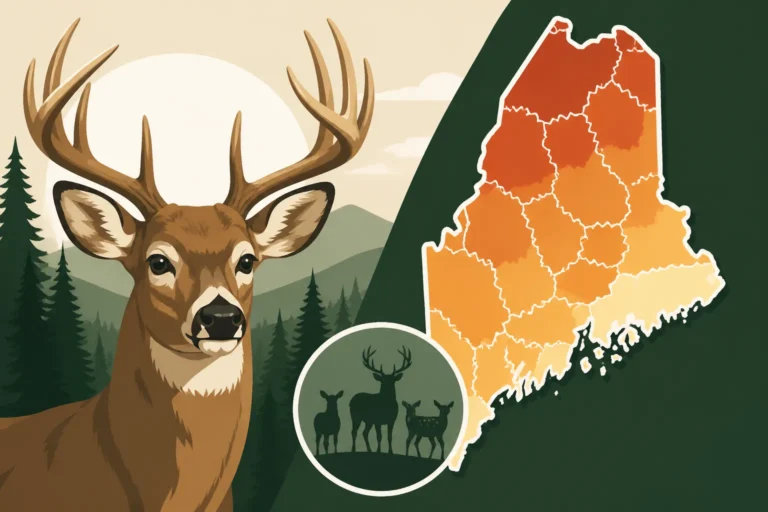
Generally speaking, you'll find higher deer densities in central and southern Maine compared to the vast North Woods. There are several clear reasons for this. Southern Maine experiences milder winters with less deep snow, which translates to better overwinter survival rates for deer. The habitat is often more fragmented, with a mix of small woodlots, agricultural fields, and suburban edges, creating an abundance of diverse food sources and cover. These areas can often feel like a deer factory to a hunter, with good numbers but potentially higher hunting pressure. You might even find yourself Hunting Small Woodlots Near Portland or Hunting Small Woodlots Near Lewiston.
Contrast that with the deep woods of northern Maine, like much of Aroostook County or the mountainous regions of Western Maine. While these areas offer unparalleled wilderness experiences, they are characterized by vast stretches of coniferous forest and notoriously deep, persistent snows that can crush a deer herd's numbers. Food sources can be more scattered, and the effort required to find deer can be significantly higher. When you are Scouting With the Maine Hunting App or Reading Aerial Photos for North Woods Deer, you will quickly see how different the landscape appears in these regions.
Maine is divided into Wildlife Management Districts (WMDs), and these are essential for understanding localized deer populations. Each WMD has unique characteristics in terms of habitat, human population, and hunting pressure, and the MDIFW manages them accordingly. A WMD in southern Maine might have a high allocation of antlerless permits due to a robust and growing deer population, while a northern WMD might have very few or none to help a struggling herd recover. This tailored approach allows for more precise management, recognizing that a "one-size-fits-all" strategy simply wouldn't work across the state.
For instance, Aroostook County, with its extensive potato and broccoli fields, offers significant food sources, but the deer often have to contend with intense winter conditions. So, while agricultural areas can hold deer, their density might not match a more temperate, food-rich central Maine locale. The coastal areas, particularly Downeast Coastal Maine, can also offer unique pockets of deer, often in thick spruce cover or near blueberry barrens. Platforms like GoHunt can be incredibly useful here, allowing you to delve into specific WMD data, harvest reports, and even historical trends, giving you a clearer picture of Deer Density by Maine Region.
Here's a general overview of deer density and hunting implications across different Maine regions:
| Region | General Deer Density | Key Factors | Hunting Strategy Implications |
|---|---|---|---|
| Southern Maine | High | Fragmented habitat, agriculture, milder winters | More deer, but often more pressure; focus on travel corridors, pinch points. Scouting is key to finding less pressured deer. |
| Central Maine | Medium-High | Mix of agriculture, forest, suburban fringe | Good balance of numbers and access; focus on food sources, clear-cuts, and thicker cover adjacent to fields. |
| Western Mountains | Medium-Low | Elevations, harder winters, mixed forest | Spot and stalk in big woods, focus on logging roads, south-facing slopes, and drainages. Expect to walk more. |
| North Woods (Industrial) | Low-Medium | Vast timberland, harsh winters, logging activity | Long walks into remote areas, focus on clear-cuts, deer wintering yards, and remote pockets of mature timber. |
| Downeast Coastal | Medium | Mixed forest, coastal influences, blueberry barrens | Focus on transition zones, edges of clear-cuts, swamps, and thicker spruce and cedar stands. |
What Maine's Deer Herd Size Means for Your Hunting Strategy
Knowing the estimated deer herd size and understanding regional densities isn't just academic; it directly influences how you should approach your hunt. It helps you set realistic expectations, plan your trips, and ultimately, increases your chances of success.
First and foremost, it means understanding that "Maine deer hunting" isn't one experience. If you're heading to the North Woods, you should prepare for a very different hunt than if you're targeting deer in a southern WMD. In areas of lower density, patience and persistence become even more vital. You might not see as many deer, but the ones you do find could be quality bucks that have grown old in less pressured environments. This often means still-hunting through thick cover, focusing on subtle sign, and being prepared to cover a lot of ground. For example, if you're Hunting a North Woods Checkpoint Tract, you'll likely be walking farther from the roads than in more populated areas.
In higher density areas, especially those with fragmented habitat, your strategy might shift to focusing on pinch points, funnels, and natural barriers that concentrate deer movement. Deer will often be patternable around food sources like agricultural fields, apple orchards, or mast crops. While you might see more deer, these animals are often more pressured, making stealth and smart stand placement crucial.
The data gathered by MDIFW, along with tools like GoHunt, can be invaluable for your pre-season scouting. You can use these resources to identify WMDs with higher success rates, understand historical harvest trends, and even pinpoint areas with significant habitat features like known deer wintering areas. Don't just show up to the woods hoping for the best; put in the time to research. Consider what types of terrain you prefer to hunt and match that with the regional densities and habitat characteristics. For instance, if you love to scout out specific food sources, you might focus on areas known for agriculture or hard mast.
Ultimately, regardless of the overall herd size or regional density, success in Maine deer hunting often comes down to adaptability and woodsmanship. Even in areas with robust populations, deer are masters of evasion. Focus on fresh sign, understand wind and thermals, and learn to read the landscape. Remember that securing your Maine Hunting Licenses and What They Cost is the first step, and pairing that with solid Maine Hunter Education Requirements knowledge and smart scouting is the recipe for a fulfilling season, no matter how many deer are estimated to be out there.
Disclaimer
This article is for general informational purposes only and does not constitute professional advice. Laws, prices and regulations vary by location and change over time. Consult a qualified professional for guidance on your specific situation.