Hunting a Ridge-Top Saddle for Rutting Bucks
Trying to pin down a mature buck during the chaos of the rut can feel like a fool's errand sometimes. You scout all summer, hang stands, pattern deer, and then November hits, and suddenly, those familiar patterns disappear, replaced by bucks cruising with a singular focus on does. It’s frustrating when your go-to spots dry up, but often, the key lies in understanding how deer move when love is in the air. This guide is all about one of those unsung heroes of rut hunting: the ridge-top saddle, and how you can leverage these natural funnels to put yourself in the game in Maine.
Understanding What Makes a Ridge-Top Saddle a Rut Hotspot
A ridge-top saddle, sometimes called a "dip" or "notch" in a ridge, is essentially a low point where the elevation drops between two higher points along a continuous ridge line. Imagine a mountain range, and then picture the lowest passes that animals would naturally use to cross from one side to the other without expending too much energy. That's a saddle. But it's not just about ease of travel; these topographical features concentrate deer movement in ways that are pure gold for hunters, especially during the breeding season.
Why Deer Gravitate Towards Saddles During the Rut
During the rut, bucks are on the move, covering significant ground in search of does. They're trying to conserve energy while maximizing their chances of intercepting a receptive doe. Saddles provide exactly that—an efficient travel corridor. Instead of having to climb all the way over a steep ridge or descend into a valley and then climb out, deer will naturally take the path of least resistance through a saddle. This is even more pronounced when you consider their need for security. A saddle often allows them to stay higher up on the landscape, giving them a better vantage point for spotting danger while still having escape routes down either side of the ridge.
It’s not just travel, though. Bucks use these natural funnels for scent checking. As they cruise through, the wind currents swirling around a saddle can carry the scent of does from both sides of the ridge, allowing them to cover more ground, scent-wise, with less physical effort. This makes them prime locations for cruising bucks, especially in the early and peak rut phases when they're actively seeking. Think of it as a natural "speed dating" corridor for deer.
Identifying Different Types of Saddles
Not all saddles are created equal, and understanding the nuances can really help you narrow down your hunting efforts. You have your classic "textbook" saddles—distinct, deep dips in a ridge that are obvious even from a distance or on a topo map. These are often used consistently. Then there are more subtle saddles, sometimes just a slight depression or a gentle slope on an otherwise uniform ridge. These might not be as pronounced, but if they offer the path of least resistance between bedding and feeding areas, or between two significant blocks of cover, deer will use them.
You’ll also find saddles that connect higher, thicker bedding cover to lower feeding areas, or saddles that act as a bridge between two distinct habitat types. For example, a saddle connecting a dense spruce thicket on one side to a more open, mature hardwood stand on the other could be a goldmine. The density of cover around the saddle also plays a huge role; thicker cover generally means more secure movement for deer, which can make them even more comfortable using these funnels during daylight hours.
| Saddle Type | Characteristics | Deer Behavior During Rut | Hunting Implication |
|---|---|---|---|
| Classic Deep Dip | Pronounced, obvious elevation drop | Consistent travel, scent checking | High probability stand site, especially for cruising bucks |
| Subtle Depression | Slight, less obvious dip on a ridge | Less frequent, but still efficient travel | Requires more precise scouting, might be less pressured |
| Cover-to-Cover | Connects two distinct bedding/feeding areas | Daily movement, security-driven travel | Excellent for morning/evening hunts, well-hidden access |
| Habitat Transition | Links different vegetation types (e.g., conifer to hardwood) | Exploit natural edge movement, thermal dynamics | Versatile for various wind directions, good for calling |
Scouting for Productive Ridge-Top Saddles in Maine
Finding the right saddle isn't about blind luck; it's a methodical process that combines aerial imagery, topographic maps, and boots-on-the-ground investigation. In Maine, with our diverse landscape ranging from the rolling hills of the Western Mountains to the vast timberlands of the North Woods, understanding the terrain is paramount. You need to become a detective, looking for clues that tell you where deer are likely to travel.
Leveraging Topographic Maps and Aerial Imagery
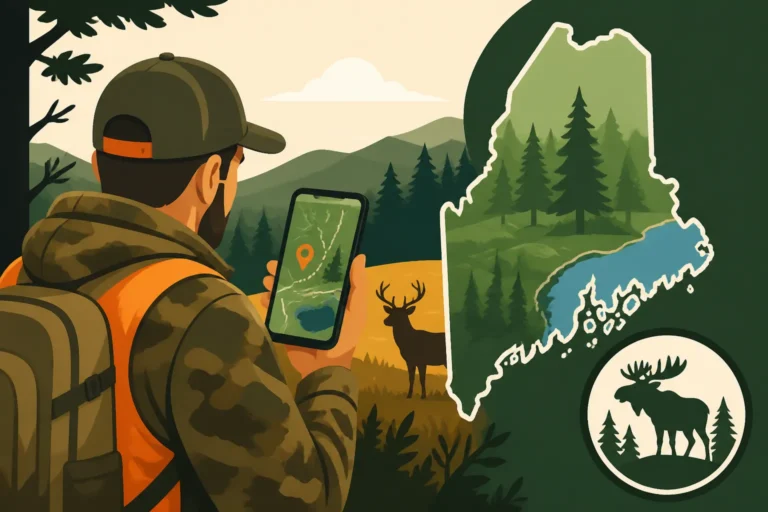
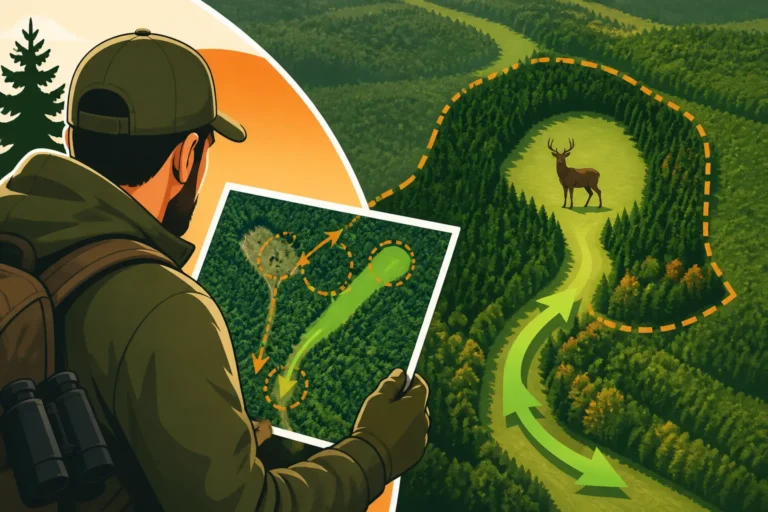
Before you ever set foot in the woods, your computer or phone can be your best friend. Tools like GoHunt or similar mapping apps allow you to virtually scout vast areas. Start by looking for prominent ridge lines. Once you've identified them, zoom in and look for those dips and notches—the saddles. Pay close attention to the contour lines: where they pinch together on either side of the ridge and then spread out in the saddle indicates a natural funnel. Look for saddles that connect key features like known bedding areas (often dense, thick cover like cedar swamps or clear-cuts with good regrowth) to feeding areas (like oak ridges, old apple orchards, or agricultural fields). You can learn a lot about how deer interact with their environment by spending some serious time studying a map. Don't forget to mark potential access routes that keep you concealed and quiet. This initial mapping phase is critical for efficient scouting and helps you eliminate unproductive areas from the start.
Boots-on-the-Ground Reconnaissance
Once you've identified promising saddles on your maps, it's time to put boots on the ground. This is where the virtual world meets reality. Visit these spots well before the season, or during the late winter and early spring when deer sign from the previous fall is still visible and the undergrowth is minimal. Walk the ridge lines and specifically check the saddle itself. What you’re looking for is hard evidence of deer traffic: well-worn trails, rubs (especially mature buck rubs from prior seasons), scrapes, and droppings.
A saddle that sees heavy rut activity will often have multiple trails converging through it. Look for older rubs that indicate consistent use by mature bucks year after year. Pay attention to the size and height of the rubs—bigger, higher rubs usually mean bigger bucks. Don't just focus on the saddle floor; check the slopes leading up to and away from it. Sometimes deer will skirt the very bottom for extra cover, or travel slightly off to one side. As you're scouting, try to visualize how deer would approach and use the saddle. Think about prevailing winds and how thermals might behave in that specific location. This ground-truthing confirms your map analysis and helps you understand the subtle nuances of the terrain that maps might miss. This is also a great time to check for suitable tree stand locations or natural ground blind cover. If you can find a saddle that provides good visibility, a clear shooting lane, and a good wind advantage, you’re well on your way. You might also find other natural funnels like where two woodlots come together.
Hunting Strategies for Maine Ridge-Top Saddles
Hunting a ridge-top saddle successfully during the rut demands a strategic approach, factoring in the time of year, weather conditions, and your chosen hunting method. The goal is always to intercept that cruising buck without alerting him to your presence. Remember, the rut is a high-stakes game, and a single mistake can blow your entire hunt.
Optimal Stand Placement and Entry/Exit Routes
Stand placement in a saddle is absolutely critical. You want to be positioned to see deer using the saddle, but more importantly, you need to ensure your scent is not blowing directly into their travel corridor. Generally, you'll want to set up downwind of the anticipated deer travel, but with saddles, wind can be tricky. Due to the topography, wind can swirl, especially in swirling thermals in Maine hill country. I’ve found that setting up slightly off to one side of the saddle, allowing for a broader view but minimizing your scent cone, can be effective. Consider multiple stand locations for different wind directions. For instance, if the prevailing wind is from the west, you might set a stand on the east side of the saddle looking west. Always prioritize a safe and quiet entry and exit. This means taking a roundabout route if necessary, avoiding any known bedding areas or major deer trails on your way in or out. Your approach should be silent and as scent-free as possible. This is where having a good understanding of Maine's deer population estimate and local deer movement helps.
Wind and Thermal Considerations
Wind is arguably the most crucial factor when hunting saddles. As mentioned, the funneling effect of a saddle can create unpredictable wind currents. Early in the morning, as the sun rises, thermals will typically rise up the slopes. In the evening, as temperatures drop, thermals will fall down the slopes into the valleys. A saddle can act like a chimney, pulling or pushing air. It’s essential to understand the predicted wind direction for your hunt, but also be aware that micro-thermals can make things unpredictable. A slight crosswind, rather than a direct headwind or tailwind, can often be advantageous in a saddle, allowing your scent to be carried across, rather than directly into, the travel path. Always carry a wind checker, whether it's a puff bottle or some milkweed seeds, and check the wind frequently. You might find that the wind at ground level in the saddle is different from the wind 20 feet up in your stand. Being adaptable to changing wind is key to hunting successfully.
Calling Strategies in a Saddle
The rut is a prime time for calling, and a saddle can amplify its effectiveness. Because deer are already moving and searching, a well-placed grunt, snort-wheeze, or rattle can be incredibly enticing. The natural acoustics of a saddle can help carry sound, and the visual cover often present around them makes bucks feel more secure about investigating. I've had success with rattling and grunting Maine bucks during the peak rut in these very spots. Start with softer calls and gradually increase the volume if you don't get a response. Often, a buck will approach from downwind, circling to get a scent check on the "intruder" he just heard. Be ready for him to appear from unexpected directions. A classic strategy is to set up a decoy if legal in your area, placing it in a visible spot within shooting range, and then calling from your stand a bit further back. This draws attention to the decoy and away from your actual position. When deer activity slows down, don't be afraid to try some more aggressive calling sequences.
Adapting to Challenges and Maximizing Opportunity
Even the best-laid plans can go awry, especially when dealing with the unpredictable nature of wild animals and the ever-changing Maine weather. Hunting ridge-top saddles isn't always easy, but understanding how to adapt to common challenges can significantly increase your odds of success.
Dealing with Hunting Pressure and Spooked Deer
Maine's firearms season is busy, and even during the archery and muzzleloader segments, you can encounter other hunters, especially on accessible public lands or tracts managed by timber companies. Hunting pressure near a Maine town or even in the deeper woods can make deer nocturnal or push them into thicker cover. If a saddle is heavily pressured, deer may still use it, but primarily at night. Your best bet is to find less obvious saddles, perhaps those requiring a longer walk, or those surrounded by exceptionally thick cover that other hunters tend to avoid. If you spook a deer near a saddle, immediately evaluate what went wrong. Was it your entry? Your scent? A sudden movement? Give that area a break for at least a few days, or even a week, before returning. Deer are smart; they'll remember where they encountered danger. Sometimes, if pressure is high, it's better to focus on the fringes of thick bedding cover adjacent to a saddle, rather than the saddle itself, catching deer just as they begin to move.
Weather's Impact on Saddle Movement
Maine weather is famously unpredictable, and it plays a huge role in deer movement. A cold front after a period of warm weather can ignite deer activity, sending bucks cruising through saddles with renewed vigor. Heavy rain can dampen movement temporarily, but often, as soon as it breaks, deer are up and on their feet, making up for lost time. High winds can make deer uncomfortable moving in open areas, but ironically, they might increase movement through sheltered saddles. Snow, especially fresh, quiet snow, can be a hunter's best friend, muffling your footsteps and making fresh tracks incredibly easy to read, helping you track a deer in fresh Maine snow. Always check the forecast and plan your hunts around favorable conditions. A dropping barometer often precedes increased activity, while a rising barometer might lead to slower movement. Be prepared for any weather, from a crisp, clear fall day to a biting December wind. This is where understanding when Maine's archery season opens and what the typical weather patterns are for the different seasons can really help you plan.
Transitioning Strategies for Different Rut Phases
The rut isn't a single event; it's a progression, and buck behavior in saddles will change with each phase. Early in the pre-rut, bucks might be checking scrapes and rub lines along the ridges leading to and through saddles. This is a great time to hunt scrape lines along a logging road or within the saddle itself. During the peak rut, when bucks are actively pursuing and breeding does, saddles become primary cruising lanes. This is your best window for encountering a mature buck during daylight. You'll often see bucks covering ground alone or actively dogging a doe. As the post-rut sets in and breeding winds down, bucks become more focused on recovering lost energy. They might still use saddles for efficient travel between feeding and bedding, but their movement will be less frantic and more deliberate. During this phase, focus on saddles that connect to late-season food sources for Maine whitetails. Understanding the timing of the rut in your specific area and adjusting your tactics accordingly is key to consistent success.
Final Thoughts on Hunting Ridge-Top Saddles
Hunting ridge-top saddles for rutting bucks in Maine is a classic strategy for a reason: it works. These natural funnels concentrate deer movement, providing excellent opportunities for hunters who take the time to scout, understand the terrain, and adapt their tactics. It requires patience, a keen eye for detail, and a willingness to learn from every hunt. Remember that GoHunt can be a powerful ally in your scouting efforts, helping you visualize the terrain and pinpoint those crucial saddles from the comfort of your home. By combining thorough map work with boots-on-the-ground reconnaissance, understanding wind and thermals, and adapting your calling and stand placement to the phase of the rut, you can significantly increase your chances of tagging a mature Maine buck.
Disclaimer
Hunting is an activity with inherent risks. Always prioritize safety, adhere to all Maine Department of Inland Fisheries and Wildlife regulations, and respect private land. This guide is for informational purposes only and does not substitute for proper hunter education, local knowledge, or professional guidance.