Maine Songbird Nest Predation by Predators
It's a disheartening discovery for anyone who loves Maine's vibrant birdlife: a songbird nest, once bustling with tiny chirping chicks, now empty or worse, raided and destroyed. This isn't just a sad sight; it's a stark reminder of the constant pressure our feathered friends face from a diverse array of predators. Understanding who these predators are, why they target nests, and what ecological ripple effects this has on our treasured songbird populations is crucial for anyone keen to appreciate and protect Maine's natural heritage. This guide will delve into the complex world of nest predation, highlighting the challenges and offering insights into how these dynamics shape our wild landscapes.
The Silent Threat: Understanding Songbird Nest Predation in Maine
The forests, fields, and coastal areas of Maine are alive with the sounds of countless songbirds, from the cheerful chickadee to the melodious hermit thrush. These small, often brightly colored birds are a vital part of our ecosystem, contributing to insect control, seed dispersal, and simply bringing joy with their presence and songs. However, their lives are fraught with peril, especially during the breeding season. The period when eggs are laid and chicks hatch is arguably the most vulnerable time for these species, as their nests become prime targets for a variety of hungry predators.
Why are Nests So Vulnerable?
Imagine trying to raise a family in a small, exposed basket, with every creature in the neighborhood potentially eyeing your precious offspring as an easy meal. That's essentially the reality for many songbirds. Their nests, often built with meticulous care, are still fundamentally fragile structures. They're typically placed in shrubs, trees, or on the ground, sometimes carefully camouflaged, other times seemingly out in the open. But camouflage is rarely foolproof against a keen-eyed or keen-nosed predator.
One of the biggest factors in nest vulnerability is their immobility. Eggs can't flee, and young chicks, especially hatchlings, are mostly helpless. They emit calls, which, while meant to attract parents for food, can also inadvertently signal their location to predators. The parents themselves, driven by instinct to protect their brood, might give away the nest's position through their vigilance or alarm calls. Furthermore, many nests are placed within easy reach of climbing animals or in areas frequently traversed by ground-dwelling hunters. The very act of parents coming and going with food can create a "beaten path" that leads predators straight to the nest. The brief period from egg-laying to fledging is a race against time and danger, where a single misstep or a moment of inattention can lead to complete nest failure.
The Unseen Impact on Our Avian Friends
While individual nest losses are a part of nature's cycle, widespread or consistently high rates of nest predation can have significant, long-term impacts on local songbird populations. It's not just about losing a clutch of eggs; it's about the cumulative effect on an entire species' ability to reproduce and sustain itself. For species that only attempt one or two broods a season, repeated nest failures can severely limit their reproductive output. This can lead to declining numbers, fewer young birds entering the breeding population, and eventually, a reduction in the overall health and diversity of Maine's avian communities.
The unseen impact also extends to the behavior of the birds themselves. Constant predation pressure can force songbirds to nest in less ideal, more concealed, or less resource-rich areas, which might still not be safe but are perceived as such. It can also influence clutch sizes or the timing of nesting attempts. When a nest is destroyed, the energy and resources invested by the parents are lost, potentially weakening them and making them less likely to succeed in a subsequent nesting attempt, if they even have the time and energy for one. It's a silent, constant battle for survival that largely goes unnoticed by most humans, yet profoundly shapes the soundscape and biodiversity of our beloved Maine wilderness.
Maine's Cast of Nest Predators: Who Are the Culprits?
Maine's diverse ecosystems support a wide array of wildlife, and unfortunately for nesting songbirds, many of these creatures are opportunistic eaters. From the smallest rodent to the largest raptor, a variety of animals are keenly aware of the seasonal bounty that bird nests represent. Understanding who these predators are is the first step in comprehending the challenges faced by our songbirds.
Mammalian Marauders
Mammals are perhaps the most diverse and persistent group of nest predators in Maine. Their varied sizes, climbing abilities, and keen senses make them highly effective at finding and raiding nests, whether they're hidden high in a tree or tucked away on the forest floor.
- Raccoons (Procyon lotor): These masked bandits are infamous for their dexterity and opportunistic nature. With nimble paws and a keen sense of smell, raccoons are adept climbers and will check every nook and cranny for a potential meal. They're particularly problematic near human settlements and agricultural areas, where they can thrive. A raccoon can easily scale a tree to reach a nest, consuming eggs or chicks with equal relish. Maine Raccoon and Skunk Trapping discusses methods that, while primarily for nuisance control, highlight the widespread presence of these animals.
- Red Squirrels (Tamiasciurus hudsonicus): Often seen as cute and harmless, red squirrels are actually significant nest predators. They're excellent climbers, highly territorial, and will readily feast on eggs and nestlings. Their small size allows them access to nests that larger predators might miss, and their sheer abundance means they exert constant pressure on nesting birds, particularly in coniferous and mixed forests. Maine Squirrel and Rabbit Populations touches on their prevalence.
- Fishers (Pekania pennanti): These sleek, agile members of the weasel family are formidable hunters. Known for their ability to pursue prey through trees, fishers are expert climbers and possess incredible speed and stealth. While they will eat a variety of small animals, bird nests, especially those of larger ground-nesting birds, are certainly on their menu. Their presence in the woods means another threat from above and below. You can learn more about their presence in the state by reading about Maine Fisher Trapping Trends.
- Foxes (Red and Gray – Vulpes vulpes and Urocyon cinereoargenteus): Both red and gray foxes are common throughout Maine and are highly adaptable hunters. While red foxes tend to prefer open woodlands and fields, gray foxes are exceptional climbers, capable of scaling trees to reach nests that other canids cannot. Both species are primarily ground hunters, but any low-lying or ground nest is highly susceptible to their keen sense of smell and cunning.
- Coyotes (Canis latrans): Maine's eastern coyotes are intelligent and adaptable predators, with a broad diet that includes everything from deer fawns to berries. While they are not typically tree climbers, ground-nesting birds and low-lying nests are certainly vulnerable. Their widespread presence means that many ground-nesting songbirds must contend with their constant patrolling. Understanding their territories and habits, as explored in Maine Coyote Range and Density, is crucial for appreciating their role in the ecosystem.
- Black Bears (Ursus americanus): Though not primary nest predators for small songbirds, black bears are opportunistic feeders. If a bear happens upon a robust ground nest, particularly those of larger birds, or can easily access a low-hanging nest, it won't pass up an easy protein source. Their curiosity and powerful sense of smell mean little goes unnoticed in their foraging paths. Their presence in the landscape is a constant factor in wildlife dynamics, as described in Maine Black Bear Denning Habits.
- Weasels (Mustela spp.) and Skunks (Mephitis mephitis): Like raccoons, weasels and skunks are ground-dwelling opportunists with excellent senses of smell. Weasels are small and quick, able to squeeze into tight spaces, while skunks are a bit more methodical, but both will readily raid nests they discover on or close to the ground. These are common inhabitants of many rural and semi-rural areas of Maine.
Avian Assassins
It's not just mammals that pose a threat; other birds, particularly larger, more aggressive species, are also significant predators of songbird nests. This is often driven by a need for protein, especially during their own breeding season, or simply opportunistic feeding.
- Crows (Corvus brachyrhynchos) and Ravens (Corvus corax): These highly intelligent and observant corvids are notorious nest predators. They work in groups, have excellent vision, and will methodically search trees and bushes for nests. Once located, they will quickly consume eggs or dispatch chicks. Their intelligence also means they learn quickly and adapt their hunting strategies. Their widespread distribution across Maine makes them a constant threat.
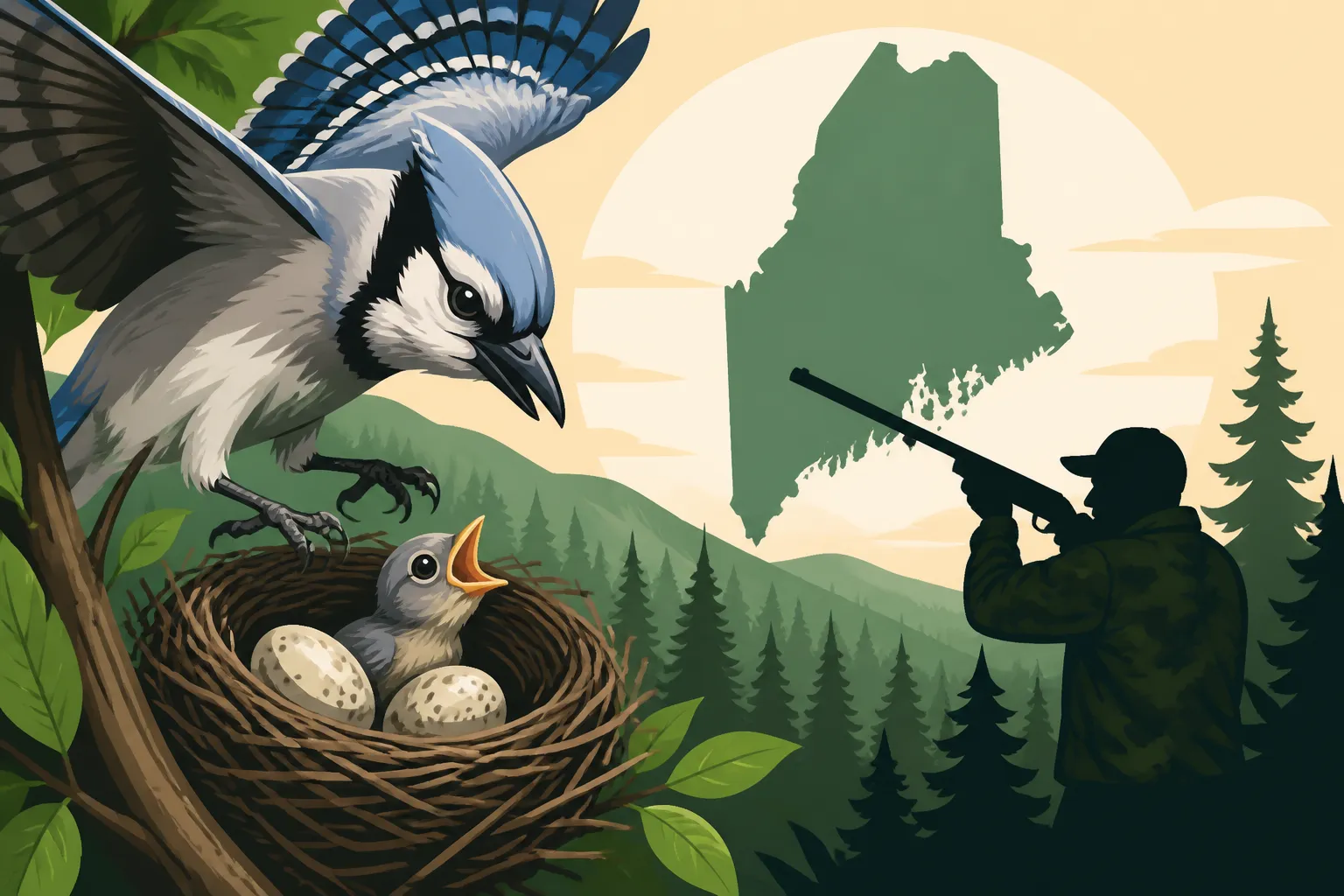
- Jays (Cyanocitta cristata and Perisoreus canadensis): Blue Jays are common and visually striking, but they also have a darker side as opportunistic nest predators. Like their larger cousins, the crows, they will actively seek out and consume eggs and nestlings. Gray Jays (also known as Canada Jays), found more in Maine's northern forests, also engage in similar behaviors. Their presence near human habitation and feeding stations often puts them in close proximity to nesting songbirds.
- Various Hawks and Owls: While many raptors primarily hunt adult birds or small mammals, some, particularly smaller owl species or those with broad diets, will take nestlings if the opportunity arises. For example, a great horned owl might not actively hunt for a small songbird nest, but if a nestling falls out or is exposed, it's an easy meal.
Reptilian and Amphibian Risks
While less commonly cited as major nest predators in Maine compared to mammals and birds, certain reptiles and even amphibians can play a role, especially for ground-nesting or very low-nesting songbirds.
- Snakes: Various snake species, particularly larger ones like the Eastern Milk Snake or Northern Water Snake, are opportunistic feeders. If a ground nest is within their range, they can consume eggs and even small hatchlings. Their ability to move silently and unnoticed makes them effective, albeit less frequent, predators of low-lying nests.
- Large Frogs and Toads: This is a rarer occurrence, but very large frogs or toads might consume a fallen nestling or one that hatches too close to the ground, though they typically don't actively raid nests. Their impact is generally localized and minimal compared to other predators.
This complex web of predators highlights the incredible odds that songbirds face each nesting season. Every rustle in the leaves, every shadow overhead, could be a potential threat to their precious brood.
| Predator Type | Key Species | Primary Nest Location Targeted | Predation Method | Impact on Songbirds |
|---|---|---|---|---|
| Mammals | Raccoon, Red Fox, Coyote, Fisher | Ground, Low Shrubs, Trees | Climbing, Scent Tracking, Opportunistic | Significant, widespread, diverse methods |
| Red Squirrel, Skunk, Weasel | Ground, Low Shrubs, Trees (squirrel) | Climbing, Scent Tracking, Opportunistic | High, especially for smaller, accessible nests | |
| Birds | Crow, Raven, Blue Jay | Mid-to-High Trees, Bushes | Visual Search, Intelligence, Group Hunting | High, particularly for open-cup nests |
| Owls, Hawks (opportunistic) | Various | Opportunistic, Predation on Fledglings | Lower direct nest predation, but take young birds | |
| Reptiles/Amphibians | Snakes, Large Frogs | Ground, Very Low Shrubs | Silent Stalking, Opportunistic | Generally low, localized, mostly ground nests/fallen |
The Ecological Ripples: Consequences for Maine's Songbirds
When nest predation rates are consistently high or increase in certain areas, the consequences extend far beyond the loss of a single brood. These losses create ecological ripples that can significantly alter bird communities, habitat use, and even the genetic diversity of species in Maine. The problem is complex, affecting the delicate balance of our natural world.
Declining Numbers and Local Extirpations
The most direct and concerning consequence of persistent nest predation is the decline in songbird populations. Each nest failure means fewer new birds are recruited into the breeding population. If predation rates are consistently high, exceeding the species' ability to compensate with subsequent nesting attempts or larger clutch sizes, the population will inevitably shrink. For species with already small or fragmented populations, or those with very specific habitat requirements, this can be particularly devastating.
Imagine a small woodlot near a developing area in southern Maine. This woodlot might be a crucial nesting spot for warblers or vireos. If raccoon and crow populations thrive in these human-modified landscapes due to abundant food sources (like trash or pet food), their predation pressure on these specific songbird nests can be relentless. Over time, that woodlot might lose its breeding population of those warblers entirely, leading to a local extirpation – where a species disappears from a specific area, even if it still exists elsewhere. This isn't an uncommon scenario, especially as Maine's landscape continues to change with development and habitat alteration. The loss of these local populations diminishes biodiversity and the overall resilience of Maine's ecosystems.
Altered Nesting Behaviors and Habitat Use
Constant predation pressure can also force songbirds to adapt their nesting strategies, sometimes in ways that aren't ideal for their long-term survival. Birds might begin to avoid historically prime nesting territories if those areas have become "predator sinks" – places where predation rates are consistently too high. This can push them into marginal habitats, which might offer less food, poorer cover, or expose them to other dangers. For instance, a species accustomed to nesting in dense undergrowth might start choosing more open areas with less predator cover if dense areas are consistently raided, simply because they've learned to associate the dense cover with high predation risk.
Furthermore, nest predation can alter clutch sizes or the timing of nesting. Some species might attempt to lay more eggs or initiate multiple nesting attempts if their first few fail, expending valuable energy and increasing their own risk of predation. Others might delay nesting in hopes of avoiding peak predator activity, or nest earlier, but these shifts can put them out of sync with optimal food availability or weather conditions. This behavioral plasticity, while a survival mechanism, can come at a cost, reducing overall fitness and reproductive success. The subtle ways birds respond to these threats are a testament to the evolutionary pressure exerted by predators, and it’s a dynamic that those of us who observe nature, perhaps even using tools like GoHunt to understand wildlife patterns, recognize as a fundamental part of the wild. Observing these shifts, even if through indirect means, underscores the importance of a healthy and balanced ecosystem.
Protecting Our Fledglings: Strategies for Mitigation and Coexistence
While nest predation is a natural part of any ecosystem, understanding its dynamics allows us to explore strategies for mitigating its impact, especially when human activities might inadvertently exacerbate the problem. It's about finding ways to support our songbird populations and foster coexistence with all wildlife, predators included.
Habitat Management and Restoration
One of the most effective ways to help songbirds is to ensure they have high-quality nesting habitat. This means creating and maintaining diverse landscapes with plenty of dense cover, various tree and shrub species, and ample food sources. For example, in residential areas or on private land, planting native shrubs and trees can provide critical nesting sites that offer better concealment than non-native ornamental plants. Dense thorny bushes, for instance, can deter some predators.
- Creating Layered Cover: Think about how a forest grows – layers from the forest floor to the canopy. Creating similar complexity in smaller areas provides multiple nesting opportunities and varying degrees of concealment. Areas like Maine Deer Wintering Yards Explained highlight the importance of dense cover for deer, and these areas often benefit small birds too.
- Controlling Invasive Species: Invasive plants like Buckthorn or Honeysuckle often create dense, but structurally weak and often monocultural, cover that might appear suitable but offers poor protection against predators. Replacing these with native plants that provide better structure and support native insect populations (a key food source for chicks) is vital.
- Protecting Riparian Zones: Stream and river banks (riparian zones) are often hotbeds of bird activity. Maintaining natural vegetation along these corridors provides crucial nesting and foraging habitat.
For those interested in general land management for wildlife, even if focusing on game species, understanding habitat composition is key. Applications like GoHunt provide mapping layers that can help identify different vegetation types, terrain features, and potential wildlife corridors, offering insights into the broader ecosystem. While not directly for songbirds, such tools can enhance one's general understanding of wildlife habitat, which applies across species.
Deterring Predators Humanely
In certain situations, particularly around residential areas or specific conservation projects, humane predator deterrence can be considered. This isn't about eradicating predators, but rather making specific areas less appealing for nesting raids.
- Securing Food Sources: Raccoons, foxes, and even bears are often attracted to human-provided food. Securing trash cans with wildlife-proof lids, bringing in pet food at night, and ensuring compost piles are properly managed can reduce the presence of these opportunistic predators in areas where songbirds are nesting.
- Exclusion: For specific, valuable nests (e.g., in research settings or highly visible community areas), physical barriers like wire cages or baffles around tree trunks can prevent climbing predators. However, this is rarely practical on a widespread scale for wild songbirds.
- Lighting and Noise: While not always effective and potentially disruptive to other wildlife, motion-activated lights or sound deterrents can occasionally startle and discourage nocturnal predators.
- Predator Control (Last Resort): In highly specific, controlled conservation scenarios where an endangered songbird species is threatened by an overabundance of a particular predator (often non-native or thriving due to human activity), targeted and humane predator removal might be considered under strict permits. This is a contentious issue and generally not applicable to the average homeowner or recreational observer.
It's important to remember that predators are a natural and necessary part of Maine's ecosystem. Our goal isn't to eliminate them, but to ensure that songbirds have the best possible chance to reproduce successfully, especially when human influence has tipped the scales too far.
The Role of Responsible Wildlife Observation and Stewardship
Every individual can play a part in reducing pressure on nesting songbirds. Responsible outdoor ethics are paramount.
- Maintain Distance from Nests: If you discover a nest, observe it from a distance. Repeated close approaches can stress the parents, cause them to abandon the nest, or inadvertently leave a scent trail for predators.
- Keep Pets Leashed: Dogs and cats, even well-behaved ones, can accidentally disturb nests or predate on fledglings. During nesting season, keep pets leashed in natural areas. Maine Landowner Relations Program emphasizes respectful use of both public and private lands, which includes pet control.
- Educate Others: Share knowledge about nest predation and responsible wildlife viewing with friends, family, and community members. The more people who understand these dynamics, the more collective effort can be put into conservation.
- Support Conservation Efforts: Local land trusts, Audubon chapters, and state agencies like the Maine Department of Inland Fisheries & Wildlife are constantly working on habitat restoration and wildlife management. Supporting their efforts, whether through volunteering or donations, contributes directly to the health of Maine's ecosystems, benefiting all wildlife, including our cherished songbirds. Understanding the broader context of wildlife management, like Maine's CWD-Free Status Explained or Maine Predator Impact on Fawn Recruitment, provides perspective on how interconnected species and management strategies truly are. Even if your primary interest is in hunting larger game, the health of the entire ecosystem, as documented through various wildlife studies, impacts all species.
By fostering healthy habitats and practicing thoughtful stewardship, we can all contribute to the continued symphony of songbirds that enriches the wild landscapes of Maine.
Disclaimer
This article is for general informational purposes only and does not constitute professional advice. Laws, prices and regulations vary by location and change over time. Consult a qualified professional for guidance on your specific situation.