Hunting a Downeast Blueberry Barren for Deer
Hunting the vast, often treeless expanses of Downeast blueberry barrens for deer can be incredibly frustrating if you don't understand how whitetails use this unique landscape. It's not like hunting thick woods or cornfields; the cover is different, the food sources shift, and the deer behave in ways that can baffle even seasoned hunters. This guide is here to walk you through the specific challenges and incredible rewards of hunting these iconic Maine barrens, helping you adapt your strategies to find success.
Understanding the Unique Appeal of Downeast Blueberry Barrens
Downeast Maine's blueberry barrens are a sight to behold, especially in the fall when the leaves turn crimson. But beyond their beauty, they present a fascinating and often overlooked hunting opportunity. Many hunters gravitate towards dense timber, leaving these more open areas relatively unpressured, which can be a huge advantage if you know what you're looking for. The key is recognizing that while these areas might look barren to us, they offer specific resources that deer find irresistible.
Why Deer are Drawn to Barrens
It might seem counterintuitive to think of deer thriving in a place that feels so open, but blueberry barrens offer a unique blend of food and thermal cover. While the low-lying blueberry bushes don't offer much in the way of visual obstruction for a deer standing upright, they provide an incredible buffet of forage. During the late summer and fall, the remaining wild blueberries are a highly palatable and energy-rich food source. Even after the fruit is gone, the browse from the woody stems of the blueberry plants, along with other low-growing shrubs and grasses that thrive in these acidic soils, provides a steady diet.
Beyond food, these seemingly flat, open areas often feature subtle undulations, small knolls, and shallow depressions that deer exploit for bedding. A deer bedded down in a low spot, even just a foot or two below the surrounding terrain, can vanish from sight, using the sparse cover to its advantage. These slight variations in topography also create microclimates, offering shelter from biting winds or direct sun, which can be crucial during the shoulder seasons. Don't underestimate the power of seemingly insignificant cover when it comes to a whitetail's ability to disappear.
Seasonal Changes and Deer Movement
Deer movement patterns in the barrens are heavily influenced by the seasonal cycle of the blueberry crop and the weather. In late summer and early fall, when blueberries are ripe, deer will often be out in the open, actively feeding. This can make for some incredible glassing opportunities at dawn and dusk. As the season progresses and the berries become scarcer, deer might shift their focus to other browse, but they'll still frequent the barrens for bedding and travel.
During the archery season, especially the expanded archery season that can stretch into December in some zones, deer might be more predictable as they follow established trails between bedding areas in the deeper woods bordering the barrens and the feeding grounds. Once the firearms season hits in November, pressure can increase, pushing deer into more secluded pockets within the barrens or driving them into the thicker spruce and fir stands that often border these areas. Understanding Maine's Four-Week Firearms Deer Season and how it impacts deer movement is crucial. Later in the season, as temperatures drop, deer will prioritize thermal cover, often seeking out the denser conifer stands or sheltered depressions within the barrens. Snow cover can reveal heavily used trails and feeding areas that were previously invisible.
Scouting Strategies for Deer in Barren Country
Successful hunting in Downeast barrens hinges on thorough scouting. Because the terrain can be so vast and open, covering ground efficiently and intelligently is paramount. You can't just wander in and expect to stumble upon deer; you need a plan, and modern tools can be a huge asset.
Reading the Landscape: Aerial Maps and Ground Recon
Before you even set foot on a barren, dive into your digital scouting. Tools like onX Hunt are invaluable for this type of terrain. Use the aerial imagery to identify subtle elevation changes – even a few feet can make a difference to a deer looking for cover or a vantage point. Look for dark green patches indicating denser conifer stands adjacent to or within the barren, as these often serve as bedding areas or escape cover. Identify potential travel corridors: fingers of higher ground, drainage lines, or even old logging roads that might cut through the barren. These often act as natural funnels for deer movement between feeding and bedding areas.
Pay close attention to property boundaries and public access points. While much of Downeast Maine adheres to Maine's Private Land Access Tradition, it's vital to know where you stand. Once you've marked a few promising spots on your map, it's time for boots on the ground. During your ground recon, focus on confirming what you saw on the map. Walk the edges of the thicker cover, checking for tracks and rub lines. Look for signs of deer feeding on blueberry bushes – clipped stems or disturbed ground. Remember, deer will often travel the path of least resistance, so any natural corridors or sheltered ravines through the barren are worth investigating closely. This type of detailed observation will help you pinpoint specific areas where deer are consistently present.
Identifying Key Deer Sign in Sparse Cover
Finding deer sign in barrens can be challenging because the low vegetation doesn't hold tracks as well as forest litter, and rubs might be few and far between on the scattered trees. You need to broaden your definition of "sign." Look for heavily traveled deer paths that lead into or out of the barrens, particularly those connecting to adjacent timber or water sources. These paths will be more compacted than random game trails and might show repeated prints.
Scat is another key indicator. Fresh droppings tell you deer are currently using the area. Pay attention to the age and size of the scat – larger, more abundant droppings often signal a mature deer. Keep an eye out for bedding areas. These might just be slightly flattened spots in the blueberry bushes, often in a sheltered dip or on the lee side of a small rise. You'll often find concentrated scat nearby. While not abundant, rubs and scrapes can be found on the occasional small pine or hardwood clump within the barren or along its edges. These are goldmines for identifying buck activity. If you're using an app like GoHunt for research, you might cross-reference general whitetail behavior patterns with what you're seeing on the ground to better interpret the sign. Remember, even faint sign in a barren can be significant, as high deer traffic tends to be localized to specific areas rather than spread evenly across the entire expanse.
| Sign Type | Best Place to Find It | What It Tells You |
|---|---|---|
| Tracks | Moist soil in low spots, trail crossings, field edges | Recent travel, direction of movement, size of deer |
| Scat | Bedding areas, feeding areas, along trails | Deer presence, freshness indicates recent activity |
| Bedding Areas | Slight depressions, lee side of knolls, dense clumps | Where deer rest, likely ambush points |
| Rubs/Scrapes | Edges of dense cover, lone trees, funnel points | Buck presence, likely pre-rut/rut activity |
| Browsing | Blueberry bushes, small shrubs | Feeding areas, preferred forage |
Tactical Approaches for Hunting Downeast Blueberry Barrens
Hunting these open landscapes requires a different mindset than still-hunting through deep timber. It’s often a game of patience, good optics, and an understanding of how deer use the available cover, no matter how sparse it seems.
Still-Hunting and Glassing Techniques
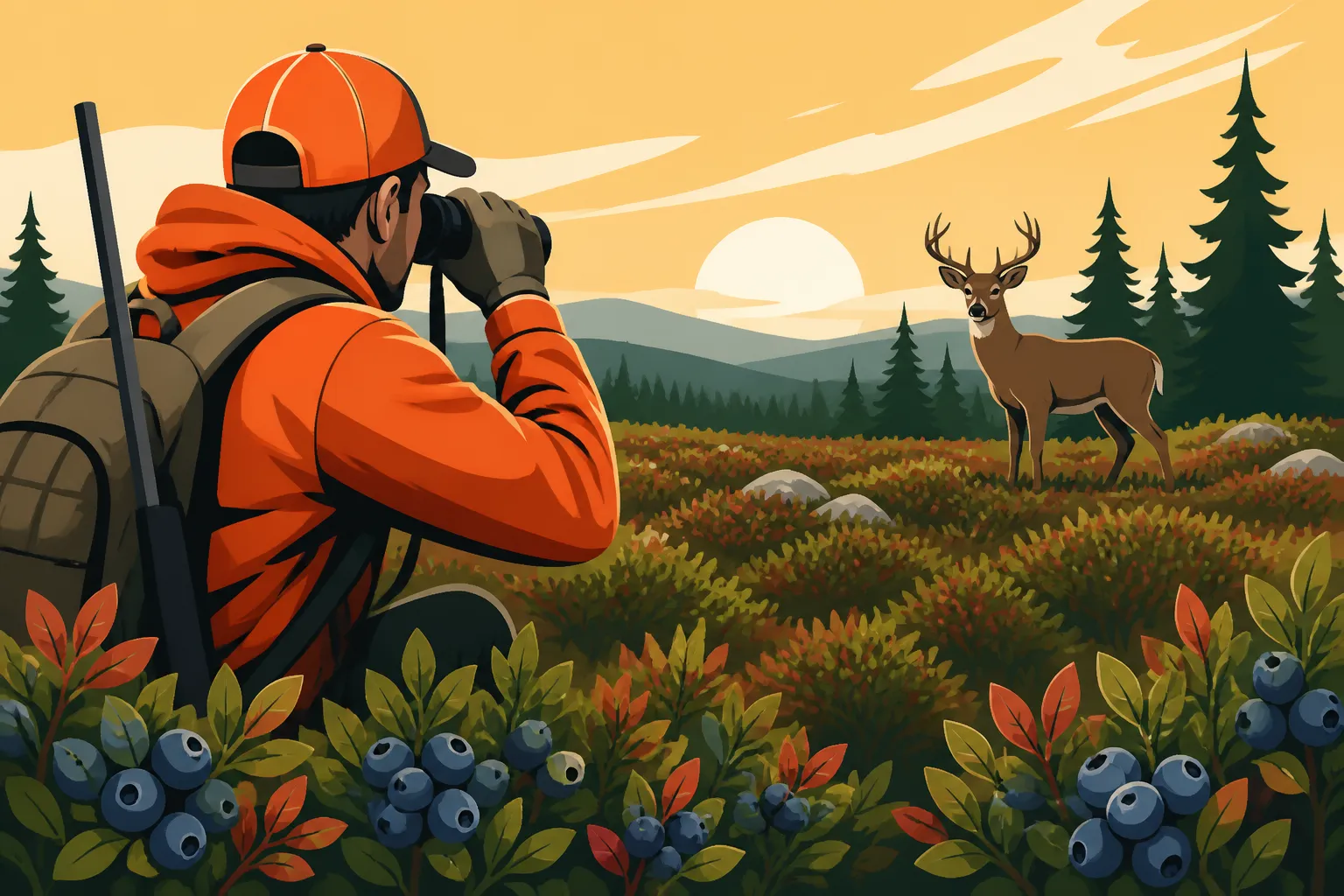
Still-hunting in the barrens is less about tiptoeing through the woods and more about moving very slowly, scanning constantly, and using available cover to break up your silhouette. Think of it as a deliberate, methodical approach where you take a few steps, then stop and glass thoroughly for several minutes. Use binoculars or a spotting scope to pick apart distant patches of cover, looking for the tell-tale horizontal line of a deer's back, an ear flick, or the gleam of an antler.
Position yourself to use the low-growing blueberries and any scattered trees or rock outcrops as natural screens. Stay low, move with the wind, and use the sun to your advantage, keeping it at your back if possible, especially during morning or evening hunts. The beauty of the barrens is the long lines of sight, but this also means deer have long lines of sight on you. Patience is key. If you spot a deer at a distance, analyze its behavior. Is it feeding, bedded, or moving with purpose? Then, plan your approach, using every dip and rise in the terrain to stay out of sight. This might involve long, circuitous routes to get into position. This type of hunting shares some similarities with Still-Hunting Aroostook County Farmland, where open vistas require careful observation and stealth.
Setting Up for Ambushes on Travel Corridors
While still-hunting is effective, setting up an ambush can be incredibly productive, especially if your scouting has revealed consistent travel patterns. Look for natural funnels where deer movement is concentrated. This could be a narrow strip of thicker cover between two large barren sections, a distinct trail leading from a timbered bedding area out to a feeding patch, or a pinch point created by a wet drainage or a property line fence.
Since large trees for treestands are scarce, ground blinds are often the most practical option. A pop-up blind brushed in with local vegetation can be incredibly effective. Position your blind downwind of the anticipated travel route, allowing plenty of time before shooting light to get settled. Consider setting up where you have a good view of a wide area but also close enough to a funnel that you can get a clean shot when a deer moves through. Remember, deer will naturally follow contours and cover. A gentle slope leading to a patch of slightly denser growth, or a transition zone between the barren and a spruce stand, are prime ambush locations. Think about setting up near Aroostook County Farmland Edge type terrain, where the edge between different cover types is key.
The Importance of Wind and Thermals in Open Terrain
In open country like the barrens, understanding wind and thermals is absolutely critical, perhaps even more so than in dense timber where swirling winds can be a constant challenge. The wind is your primary scent killer, and in the barrens, it often blows more consistently and can carry your scent for long distances. Always hunt with the wind in your favor, positioning yourself downwind of where you expect deer to appear.
Thermals, the rising and falling air currents influenced by temperature changes, play a significant role at dawn and dusk. In the morning, as the sun warms the earth, thermals will rise, carrying your scent upwards. In the evening, as the air cools, thermals will fall, carrying your scent downwards into low-lying areas. This means a deer in a low dip during an evening hunt might catch your scent, even if the prevailing wind is seemingly in your favor. Combine this knowledge with the terrain: if you're hunting an elevated position in the evening, your scent will likely fall into the valley below. Conversely, in the morning, your scent will rise. Mastering Wind and Thermals in Maine Hill Country will greatly increase your odds of success in the barrens, as the principles apply similarly. Always plan your entry and exit routes to minimize alerting deer with your scent.
Essential Gear and Considerations for Barren Hunting
Hunting the Downeast barrens means you'll encounter a specific set of conditions. Being prepared with the right gear can make or break your hunt, from comfort to effectiveness.
Optics and Long-Range Visibility
Given the expansive nature of blueberry barrens, good optics are not just a luxury; they're an absolute necessity. A quality pair of binoculars, at least 10x magnification, will be your best friend for scanning vast distances. Many hunters opt for 12x or even 15x binoculars for even greater reach. Pair this with a good spotting scope on a stable tripod if you plan to sit and glass for extended periods from a high vantage point. The ability to distinguish a deer from a distant stump, or to spot a subtle antler tine in a patch of low cover, comes down to the clarity and magnification of your glass.
I often recommend investing in the best optics you can afford. It's truly a game-changer when you're trying to pick apart acres of low-lying vegetation. While an app like GoHunt might give you data on areas, nothing replaces the real-time visual information from quality optics. When using them, scan slowly and deliberately, looking for patterns that break up the natural lines of the landscape. Sometimes, it's not the whole deer you see, but just a part of it – an ear, an eye, a leg.
Footwear and Clothing for Variable Terrain
The terrain in Downeast barrens can be surprisingly varied, even within a single area. You might encounter dry, rocky knolls, wet, boggy depressions, and thick, thorny patches of brush. This calls for versatile and durable footwear. Waterproof boots are a must, ideally with good ankle support and aggressive tread for stability on uneven ground. You'll be doing a lot of walking, potentially miles in a day, so comfort is paramount to avoid blisters and fatigue.
For clothing, think layers. Temperatures in Maine, especially Downeast, can fluctuate wildly from morning to midday, and cold, damp winds can cut right through you. A wicking base layer, an insulating mid-layer, and a waterproof/windproof outer shell are ideal. Blaze orange requirements are in effect during firearms season, so make sure your outer layer meets the legal standards. Camouflage patterns that mimic sparse, open country or transitional zones can be effective, but remember to prioritize safety with appropriate orange during regulated seasons. When you’re still-hunting, silence in your clothing is also critical, as any rustle can carry far in the open air. This approach to clothing is similar to preparing for Cold-Weather Sitting Strategy in Maine, emphasizing warmth and moisture management.
Disclaimer
This article is for general informational purposes only and does not constitute professional advice. Laws, prices and regulations vary by location and change over time. Consult a qualified professional for guidance on your specific situation.