Hunting a Powerline Cut Through the North Woods
Hunting in the vastness of Maine's North Woods can feel like an overwhelming endeavor, a sea of dense timber where finding game, let alone a clear line of sight, can seem impossible. Many hunters feel this frustration, wondering how to effectively cover so much ground. The good news is that certain features, like powerline cuts, act as literal highways and dining halls for wildlife, offering unique opportunities for success if you know how to approach them. This guide will help you understand why these cuts are so valuable and how to hunt them effectively, transforming what might seem like an obstacle into your next prime hunting spot.
Why Powerline Cuts Are Prime Hunting Real Estate
When you look at a map of the North Woods, the sprawling, unbroken forest can be daunting. Then you spot those thin, ruler-straight lines carving through the landscape – powerline cuts. These aren't just utility corridors; they're dynamic ecological features that dramatically influence game movement and habitat use, creating some of the most consistent hunting opportunities in an otherwise formidable environment.
The "Edge Effect" and Habitat Diversity
Powerline cuts are the epitome of the "edge effect." This ecological principle states that areas where two different habitat types meet tend to have a greater diversity and abundance of wildlife than either habitat type alone. On one side of the powerline, you have mature forest, offering cover, bedding areas, and mast crops. On the other side, you have the open, regenerating strip of the powerline itself. This cut, regularly maintained to prevent tree growth, becomes a haven for young saplings, shrubs, and grasses that thrive in the sunlight. Deer, moose, and even bear are drawn to this buffet of fresh browse.
Think about it from a deer's perspective: they can bed down in the thick spruce or hardwood stands right at the edge of the cut, enjoying protection from the elements and predators. Then, with just a few steps, they can emerge into the cut to feed on the tender shoots and forbs that grow there. This constant availability of both food and cover, often side-by-side, makes these edges incredibly attractive, concentrating game in predictable patterns. This combination of security and sustenance is exactly what makes these linear clearings so magnetic to wildlife.
Natural Travel Corridors and Browse
Beyond the edge effect, powerline cuts serve as crucial travel corridors for animals moving through the dense Maine woods. Imagine a deer or a moose trying to navigate miles of tangled blowdowns, thick alders, and dense spruce. It's slow, noisy, and energy-intensive. A powerline cut, even with its own regenerating growth, often offers a relatively easier path. Animals will use these cuts to move between different feeding areas, bedding sites, and even to cross drainages or ridges.
These cuts are also invaluable for providing consistent browse. Young maple, aspen, willow, and various berry bushes, which are critical food sources for deer and moose, flourish in the sunlight. Unlike a fleeting mast crop from oak or beech trees, this browse is available throughout the hunting season. You’ll often find signs of heavy browsing, rubbed saplings, and well-worn trails running both perpendicular to the cut (as animals enter and exit the woods) and parallel to it (as they travel its length). Recognizing these patterns is key to successful hunting here, much like Scrape Lines Along a Logging Road can indicate deer activity.
Visibility and Shot Opportunity
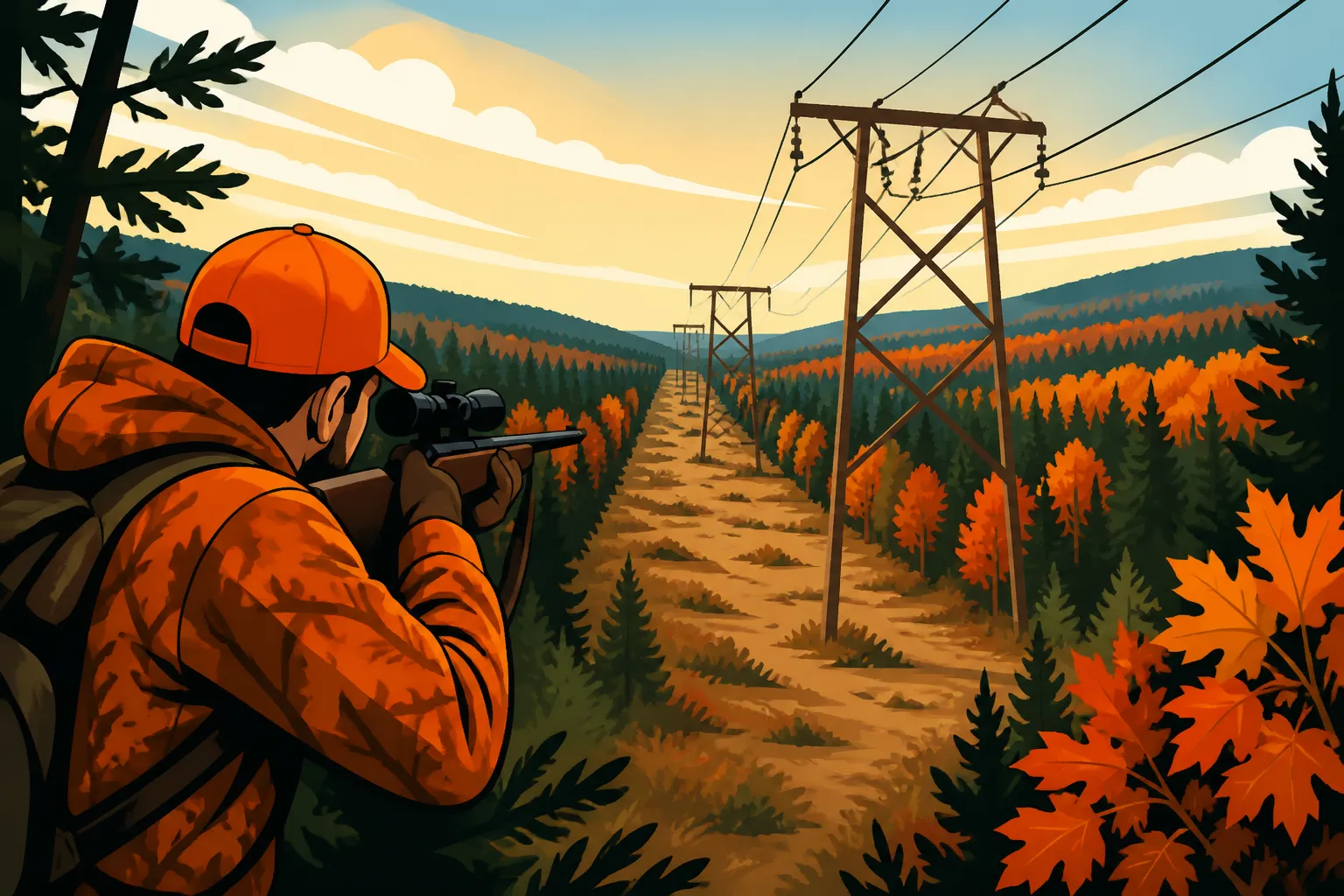
In the thick woods of Maine, getting a clear shot beyond 50 yards can be a rarity. The sheer density of the forest, combined with rolling terrain and thick undergrowth, often limits your effective range to mere bow distances even during rifle season. This is where powerline cuts truly shine. Their open nature provides extended visibility, sometimes for hundreds of yards in either direction. This significantly increases your shot opportunities, especially for those longer rifle shots you might practice all summer.
While the cut itself offers openness, the edges still provide cover for the hunter. You can position yourself within the timber, just inside the treeline, giving you concealment while still commanding a wide view of the open lane. This combination of concealment for the hunter and visibility for the shot is a massive advantage, allowing you to observe game movement, assess animals, and make an ethical shot without being spotted prematurely. It can dramatically change your approach compared to Still-Hunting Western Maine Mountain Slopes where visibility is often measured in feet, not yards.
Scouting and Planning Your Powerline Hunt
Successful hunting in a powerline cut, especially in the vastness of the North Woods, isn't about aimlessly wandering. It requires meticulous scouting and planning, often done long before you ever set foot in the woods. Modern technology has truly revolutionized this aspect, allowing you to unlock the secrets of these linear clearings from your living room.
Mapping Tools Are Your Best Friend
Forget the days of relying solely on paper topo maps (though they still have their place!). Digital mapping applications have become indispensable for scouting powerline cuts. Tools like onX Hunt and GoHunt provide satellite imagery, topo maps, land ownership layers, and even timber harvest data that can give you a massive advantage. I can't stress enough how much time and boot leather these apps can save you. You can zoom in and identify exactly where a powerline crosses a drainage, where it funnels between two woodlots, or where there's a particularly dense patch of regenerating growth that might hold deer.
Use the satellite imagery to identify variations within the cut itself – areas of thicker brush versus more open stretches. Look for evidence of old logging roads or trails that might intersect the powerline, providing both potential access points and additional travel corridors for game. The land ownership layers are crucial in Maine, where a mix of private and industrial timberland dominates, alongside public access. Knowing whose land you're on, or confirming it's open to hunting, is paramount. onX Layers for Maine Land Status can be an absolute game-changer for this. These apps allow you to mark waypoints for potential stand locations, track game trails, and plan your entry and exit routes with precision.
Locating Key Features Within the Cut
Once you've identified a promising powerline segment on your map, it's time to virtually scout for specific features. Not all sections of a powerline are created equal. You’re looking for those subtle topographical or vegetational nuances that concentrate game.
- Drainage Crossings: Where a powerline crosses a brook, swamp, or low-lying area, these spots often become natural travel corridors, as animals prefer to use the easiest path across varied terrain. Look for pinch points where the higher ground narrows around the wet area.
- Funnels and Bottlenecks: Identify areas where the powerline narrows significantly, or where dense timber on both sides forces animals into a smaller crossing area. This could be a small gap between a pond and a thick stand of evergreens, or where two distinct timber types meet the cut.
- Heavy Browse Areas: Pay close attention to sections with particularly dense regenerating growth. These are the natural feeding areas. Look for different shades of green or texture in the satellite imagery indicating younger, succulent growth.
- Edge Irregularities: Deer and moose often prefer to use edges that aren't perfectly straight. Look for subtle bends, points, or small pockets of timber that jut out into the cut, as these provide extra cover and an advantage point for animals. A thorough ground scout to confirm these features, looking for actual tracks, droppings, and rubs, is always the next step after your digital reconnaissance. Finding Sign in Big North Woods Timber is a skill that will serve you well here.
Accessing Remote Powerline Sections
One of the biggest hurdles when hunting powerline cuts in the North Woods is access. Many of the most productive sections are deep in remote, unmaintained areas, often within the larger industrial timberlands like the North Maine Woods. You can't just drive up and park. Access often means utilizing a network of logging roads, some active, some abandoned.
You'll need to research which logging gates are open, if permits or fees are required (like those for The North Maine Woods Gate System), and if certain roads are only open during specific seasons. Sometimes, the only way to reach a prime section of powerline is by foot, or perhaps by ATV on designated trails, after a significant drive down rough roads. Plan your approach carefully, considering how far you're willing to walk, and remember that every mile you walk in, you'll have to walk out with your gear – and hopefully, a deer or moose. Always have a backup plan for recovery, especially if you're venturing into truly remote areas where help might be hours away. Understanding these logistics is as important as the hunt itself.
Effective Hunting Strategies for Powerline Cuts
Hunting a powerline cut successfully goes beyond just finding a good spot; it's about understanding how animals use these corridors and adapting your tactics accordingly. Whether you prefer to move slowly or sit patiently, there are specific strategies that will boost your chances significantly in these unique environments.
Still-Hunting the Edges
Still-hunting is a highly effective tactic along powerline edges, especially during the early and mid-season when deer and moose are still actively browsing. This involves moving incredibly slowly, taking a few steps, and then pausing for several minutes to scan, listen, and observe. You’re not just looking for an entire animal; you're looking for movement, a horizontal line, a twitch of an ear, or an unnatural shadow.
Position yourself just inside the treeline, ideally with the wind in your favor, so you have concealment but can still peek out into the cut. This allows you to pick apart the regenerating growth within the powerline itself, where deer might be feeding, as well as the dense timber directly to your side. Focus on areas where the cut bends, changes elevation, or where you've identified specific features like drainage crossings or thick pockets of browse during your scouting. Move only when you've thoroughly scrutinized your immediate surroundings. The goal is to surprise game, not to be surprised by it. This slow, methodical approach is also excellent for covering ground quietly, just like Still-Hunting Aroostook County Farmland focuses on quiet movement along field edges.
Setting Up Ambushes at Crossings
Powerline cuts, especially those running through vast timber blocks, often act as major thoroughfares. Animals will use specific points to cross from one side of the woods to the other, or to access different feeding and bedding areas. Identifying these natural crossing points is where setting up an ambush truly shines. Look for well-worn game trails that emerge from the timber, cross the powerline, and disappear back into the woods on the other side. These are your prime locations.
A ground blind brushed into the edge of the timber, or a treestand carefully positioned to overlook a crossing, can be deadly. Consider the prevailing wind direction for your setup and approach. You want your scent to blow away from the anticipated travel route of the game. Animals often become cautious at these open crossings, sometimes pausing at the edge to scan for danger before committing to crossing. This pause can give you the precious seconds needed to make a shot. Early mornings and late evenings, especially at Glassing a Powerline Cut at Last Light, are prime times for these ambushes, as animals move between bedding and feeding areas.
Understanding Wind and Thermals
In any hunting scenario, understanding wind and thermals is critical, but in powerline cuts, it takes on a unique dimension. The long, open corridors of powerlines can channel and distort wind patterns in unpredictable ways. Instead of a consistent directional breeze, you might experience swirling gusts, especially if the powerline crosses varied terrain like hills or valleys.
- Wind Direction: Always try to position yourself downwind of where you expect game to appear. However, be aware that the cut itself can create micro-eddies. Use a wind checker frequently.
- Thermals: In the mornings, as the sun heats the ground, warm air (thermals) typically rises up slopes. In the evenings, as the air cools, thermals drop down into valleys. If your powerline cut runs up or down a ridge, factor this into your setup. Animals moving uphill in the morning or downhill in the evening will often have their noses to the wind, using these rising or falling air currents to detect danger. Setting up slightly above a crossing in the morning, or slightly below it in the evening, can often put you in a better position to intercept them before they smell you.
Common Challenges and How to Overcome Them
Hunting powerline cuts in the North Woods, while rewarding, isn't without its challenges. The very features that make them attractive can also pose hurdles. Being prepared for these realities will ensure a safer, more enjoyable, and ultimately more successful hunt.
Dealing with Thick Regrowth
While regenerating growth provides excellent browse, it can also become incredibly dense, especially in older cuts that haven't been recently maintained. We're talking about chest-high alders, thick stands of young spruce, and thorny berry bushes that can make walking and seeing a real chore. This dense cover, while great for wildlife, can be exhausting to navigate and can severely limit visibility for the hunter.
Overcoming it:
- Scout for "trails" within the regrowth: Animals will often create their own trails through the thickest parts. Identifying and using these can save you energy and offer clearer lines of sight.
- Use the edges: Stick to the very edge of the mature timber, where the canopy might reduce some of the ground-level thickets, providing an easier walking path and better visibility into the cut itself.
- Elevated positions: If you can find a natural rise or a suitable tree for a stand just inside the timber, getting above the immediate thicket can greatly improve your visibility.
- Patience: Moving through thick growth demands patience. Rush it, and you'll make noise, push game out, or trip. Slow down, make less noise, and you'll increase your chances.
Managing Hunter Pressure
The "secret" of powerline cuts being game magnets is, of course, not entirely a secret. These easily identifiable features often attract other hunters, especially in more accessible areas. Encountering other hunters can ruin a hunt and even create safety concerns.
Overcoming it:
- Go deeper: The further you're willing to walk, the less pressure you'll generally encounter. This is where your detailed mapping and access planning (from the previous section) becomes crucial. Identify powerline sections that are a mile or more from the nearest accessible road.
- Hunt during weekdays: If your schedule allows, hunting on a Tuesday or Wednesday will almost always mean less competition than a busy Saturday.
- Utilize less obvious features: While the obvious crossing points are good, try to find subtle funnels or feeding areas away from the most trafficked sections of the cut. Sometimes, a small bend or a slightly different vegetation type will hold deer that others walk past.
- Early season advantage: During When Maine's Archery Season Opens, there's generally less pressure than during the peak firearms season. This can be a great time to explore powerline cuts.
Extraction Logistics
Harvesting a deer or moose deep in the North Woods, especially from a remote powerline cut, presents a significant logistical challenge. Unlike a field edge hunt where your truck might be 100 yards away, you could be miles from the nearest vehicle access point. Getting an animal out cleanly and efficiently is a critical part of the hunt.
Overcoming it:
- Pack light, but bring essentials: Always carry a quality game bag, rope, and perhaps a small folding saw or hatchet for quartering. These tools are far more valuable than extra snacks when faced with a downed animal.
- Quartering is key: For larger game like moose or even big deer, field dressing and quartering the animal is often the only realistic way to get it out of the woods. This lightens the load and makes it manageable for backpack hauling. Know how to do this efficiently before you go. Field Dressing a Moose in the North Woods applies to the technique, regardless of species.
- Game carts/sleds: If the terrain allows, a sturdy game cart can be a lifesaver for hauling a deer. In snowy conditions, a plastic sled is invaluable. However, consider the type of terrain you'll be navigating; deep mud, thick brush, or steep slopes can render a cart useless.
- Hunting with a partner: Having a hunting buddy isn't just about company; it's about sharing the workload for extraction. Two people can typically haul out a deer much faster and more safely than one.
- Pre-plan your route: Before you even start hunting, look at your map and identify the easiest, most direct route back to your vehicle from potential kill zones. Consider slopes, wet areas, and dense timber. Sometimes, a slightly longer route on an old logging road is easier than a direct, brutal bushwhack. Remember to always bring along your Maine Hunting Licenses and What They Cost and all other necessary permits.
| Species | How Powerlines Are Used | Optimal Hunting Season | Best Time of Day |
|---|---|---|---|
| White-Tailed Deer | Feeding on browse, travel corridors, rutting activity along edges | Expanded Archery, Firearms, Muzzleloader | Early morning, late evening |
| Moose | Browse, crossing large timber blocks, bull searching for cows | Moose Lottery Season (September/October) | Early morning, mid-day (shade) |
| Black Bear | Feeding on berries/forbs, travel between feeding areas | Bait Season (Sept.), Hound Season (Oct.) | Dawn, dusk, mid-day (cooler temps) |
| Coyote | Patrol edges for small game, travel | Year-round, often after deer season | Night (with permits), dawn/dusk |
Disclaimer
This article is for general informational purposes only and does not constitute professional advice. Laws, prices and regulations vary by location and change over time. Consult a qualified professional for guidance on your specific situation.