Wind and Thermals in Maine Hill Country
There’s nothing quite as frustrating as carefully sneaking into your prime hunting spot, only to have a swirling gust of wind betray your presence to every whitetail within a quarter-mile. Maine's hill country, with its mix of rolling terrain, deep draws, and varied timber, presents unique challenges when it comes to understanding and predicting wind and thermal currents. This guide will help you decipher these invisible forces, giving you a critical edge for a more successful and less frustrating hunting experience.
Understanding the Invisible Hand: Prevailing Winds
Wind, in its simplest form, is the movement of air, but in Maine's varied topography, it's rarely simple. Beyond the general direction your weather app tells you, localized terrain features can drastically alter how that wind behaves, especially in areas we fondly refer to as "hill country." You might be thinking you've got a steady northwesterly, only to have your scent swirl right back into the cover you just walked past.
How Topography Manipulates Airflow
Imagine the wind as a river. When that river hits an obstruction, like a rock or a bend, it doesn't just stop; it changes course, creates eddies, or funnels through narrower passages. The same principle applies to wind interacting with Maine's hills, ridges, and valleys. A prevailing wind can be quite stable over flat, open ground, but as soon as it encounters a rise or fall in elevation, it's forced to adapt. It will climb over a ridge, creating a downdraft on the leeward side, or it will be channeled down a valley, picking up speed.
For instance, if you're hunting a long ridge that runs east to west, and the prevailing wind is from the north, that wind will hit the northern slope, climb over the crest, and then roll down the southern slope, often creating confusing eddies right at the top. The leeward side of the ridge, while seemingly sheltered, can actually become a swirling vortex where your scent can be carried in unexpected directions. Conversely, a wind blowing parallel to a valley might get compressed and accelerate through the narrowest parts, creating a wind tunnel effect. Knowing this allows you to anticipate where your scent cone will truly travel, rather than just guessing. This level of detail in understanding the land can be invaluable when you're Scouting Maine Private Land Before Season.
Reading Environmental Cues for Wind Direction
While your weather app gives you a macro view, the micro-level wind patterns you need to be aware of can only be read on the ground. Hunters in Maine have long relied on subtle environmental cues to pinpoint actual wind direction at their immediate location. Forget licking your finger; there are far more reliable, and frankly, less awkward, methods.
Milkweed seeds are absolute gold for this. Carry a few pods in your pocket, and when you're unsure, gently release a few seeds. Watch how they drift, rise, or fall. Even the smallest puff of air will carry them, giving you a real-time, three-dimensional look at the wind. Alternatively, a small squeeze bottle of unscented talcum powder or a commercial wind-checker bottle (often filled with a fine, scentless powder) works wonders. Spray a little puff into the air and observe its movement. Pay attention not just to direction, but also to its behavior – is it dropping quickly, indicating a downdraft? Is it swirling, signaling an eddy? You can also look for subtle movements in the finest twigs on tree branches, the rustling of dry leaves, or the way tall grass bends. Even something as simple as the smoke from a distant chimney can give you a general idea of the prevailing wind direction high above the canopy. These small observations are crucial for staying undetected, particularly when you’re attempting to Still-Hunting Western Maine Mountain Slopes where the terrain often dictates these micro-currents.
Deciphering Thermals in Rolling Terrain
Thermals are the unsung heroes and villains of hunting in undulating terrain. Unlike prevailing winds, which are driven by larger weather systems, thermals are localized air currents created by changes in temperature. They might be less dramatic than a blustery gale, but their consistent, daily patterns can make or break a hunt, especially during those crucial morning and evening hours.
The Daily Cycle of Rising and Falling Air
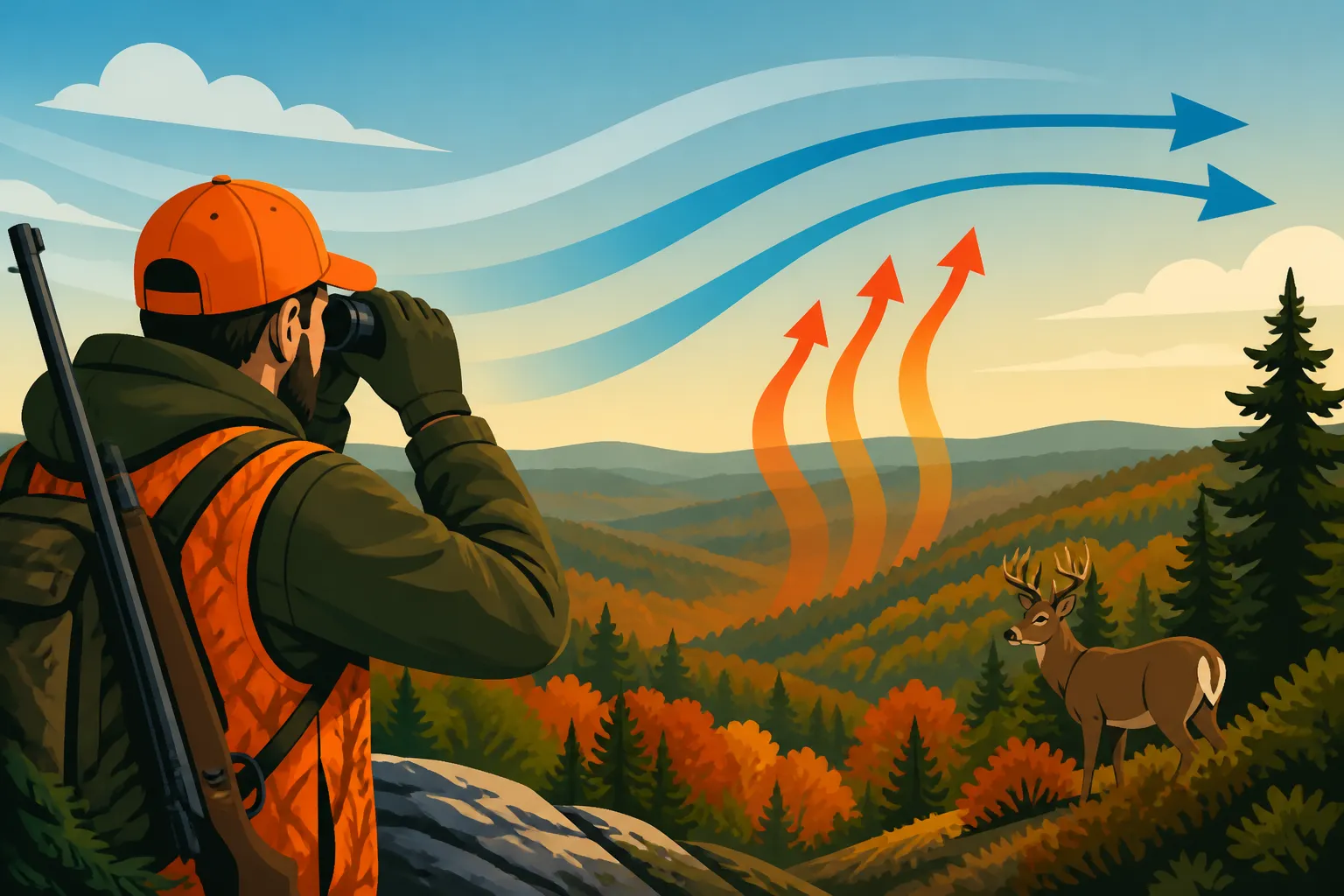
At its heart, a thermal is simply air moving due to temperature differences. Warm air rises, and cool air falls. This fundamental principle creates a predictable daily cycle in Maine's hill country:
- Morning Thermals (Upslope): As the sun begins to hit the eastern slopes of hills and ridges, the ground warms up. This warm ground heats the air directly above it, causing that air to become less dense and begin to rise. This creates an upslope thermal, pulling air (and your scent) from the valley bottoms up towards the ridge tops. This effect can start even before the sun is fully over the horizon, as residual heat from the day before or the first indirect rays begin to take hold. Deer and other game are acutely aware of this and will often move down into valleys or thicker cover to feed or bed overnight, then slowly work their way back up as the thermal rises, using the rising air to carry their scent away from any predators below.
- Evening Thermals (Downslope): As the sun sets and the land begins to cool, the process reverses. The air on the higher elevations cools faster than the air in the protected valleys. This denser, cooler air starts to flow downslope into the valleys and draws. This creates a downslope thermal, carrying scent from the ridge tops down into the low-lying areas. This can start a few hours before actual sunset and intensify as darkness falls. Deer often use these falling thermals to move down to evening feeding areas in fields or clearings, confident that their scent is being carried downwards and not alerting anything below them. Understanding these patterns is key when considering your approach for Hunting the Rut in Early November, as bucks will be moving constantly.
Factors Influencing Thermal Strength
While the general upslope/downslope pattern is reliable, the strength and timing of these thermals can vary significantly based on several factors unique to our Maine landscape.
- Sunlight Exposure: South-facing slopes, catching more direct sunlight, will warm up faster and generate stronger morning thermals sooner than north-facing slopes. Conversely, north-facing slopes will retain cooler air longer into the day and contribute to stronger evening downdrafts. This is a critical consideration when deciding where to place a stand or position yourself. A south-facing slope might be great for an early morning sit, but if you're on the north side expecting thermals to shift, you might be waiting a long time.
- Vegetation and Ground Cover: Open, rocky slopes or areas with thin vegetation will heat and cool much faster than heavily timbered areas with thick leaf litter or dense evergreen cover. Dense conifer stands, common in much of Maine, act like insulation, trapping cooler air. Open fields or recently clear-cut areas, on the other hand, will quickly absorb and release heat, amplifying thermal effects. A dark, wet cedar swamp, for example, will retain cold air much longer than a sun-baked hardwood ridge, and that difference in temperature can create its own micro-thermal draw.
- Humidity and Cloud Cover: High humidity or heavy cloud cover will dampen thermal activity. Clouds block solar radiation, reducing the warming effect, and humidity makes air more resistant to temperature changes. On clear, crisp days, thermals will be much more pronounced and predictable. If you have a heavily overcast day, the prevailing wind will typically be the dominant factor, as thermal generation is minimal. This is important to remember when planning your setup, especially for a Cold-Weather Sitting Strategy in Maine where clear, cold conditions amplify these effects.
Combining Wind and Thermals for Effective Hunting
This is where the art and science of hunting truly merge. It's rarely just about the wind, or just about the thermals. Most often, it's about how they interact, and understanding this interplay is what separates consistently successful hunters from those who constantly get busted. Maine's diverse hill country, from the foothills of the western mountains to the rolling terrain of Washington County, demands a nuanced approach.
The "Thermal Drift" and Transition Times
The most challenging, and often misunderstood, aspect of wind and thermals is during the transition periods: dawn and dusk. This is when thermals are either building or dying, and they often create a "thermal drift" that can override or significantly alter the prevailing wind.
- Morning Transition: As the sun rises, the cool, heavy air from the night starts to lift. The downslope thermal weakens and then reverses, giving way to an upslope thermal. For a brief window, usually an hour or two after first light, the air can be incredibly "swirly" or unpredictable. You might feel a gentle upslope thermal for a few minutes, followed by a light downdraft, then back again. This is because the ground is warming unevenly, and the prevailing wind might be trying to assert itself. Experienced hunters know this is a high-risk time. It's often best to position yourself slightly below where you expect deer to be, or on a bench where you have multiple escape routes for your scent. Many a seasoned hunter has seen their morning hunt ruined by this unpredictable shift. This is also a good time to consider how your approach to a stand differs from Hanging a Stand on a Private Land Field Edge, where thermals might be less pronounced but prevailing winds are dominant.
- Evening Transition: Similarly, as the sun begins its descent, the day's upslope thermal gradually weakens. The air on the ridge tops cools, becomes heavier, and begins to spill downslope, creating the evening downdraft. Again, there's a window of unpredictable, swirling air as the two forces battle. During this time, your scent might briefly rise, then quickly fall. As a rule of thumb, it's generally safer to be above where you expect deer to be in the evening, letting the falling thermal carry your scent safely over their heads. However, if the prevailing wind is strong, it can often keep the thermals from fully developing, making the prevailing wind the dominant factor. Using tools like the GoHunt app to check precise wind forecasts, alongside terrain features, can help predict these challenging transitions.
Strategic Positioning: Playing the Currents
Once you understand how wind and thermals interact, you can begin to make strategic choices about your stand placement and approach.
- Ridge Saddles and Funnels: These are classic deer highways, but they're also notorious wind traps. During the day, a prevailing crosswind might funnel through a saddle, creating a consistent current. However, at dawn and dusk, thermals can cause swirling air right in the saddle, pushing scent over both sides or straight up. To counter this, consider setting up just off the saddle, on the downwind side of the expected deer travel, or slightly elevated if you anticipate a morning upslope thermal. When Hunting a Ridge-Top Saddle for Rutting Bucks, understanding these dynamics is paramount.
- Valley Floors and Draws: In the mornings, valleys are thermal chimneys, pulling air straight up. This means if you're sitting in the bottom of a draw and deer are above you, they'll likely smell you. For morning hunts, it’s often better to climb higher on the leeward side of the draw, letting the rising thermal carry your scent away and above the deer. In the evenings, however, these draws become thermal sluices, with air (and your scent) flowing rapidly downhill. This makes evening hunts in valley bottoms excellent if you can get above the deer, letting the falling air protect your position.
- Benches and Terraces: These flatter areas on a hillside can create micro-eddies or pockets where the wind behaves differently from the main slope. A bench might hold stagnant air, or a slight rise on a bench could deflect a thermal temporarily. Paying close attention to how these smaller features affect scent movement is crucial. Use your wind checker frequently in these spots. A digital scouting platform, like GoHunt, can help you visualize these benches and terraces on a topo map, aiding in planning your approach.
Real-World Scenarios and Adaptations in Maine's Hill Country
Applying the knowledge of wind and thermals isn't just theory; it's about practical adaptation to the ever-changing conditions in the Maine woods. Every hunt offers a new puzzle, and the ability to solve it on the fly is a hallmark of an effective hunter.
Morning Hunts: Climbing Above the Thermals
Let's imagine a classic Maine morning scenario. You're hunting a hardwood ridge bordering a clear-cut that deer use for browsing. The prevailing wind is light from the northwest, but it's a clear, cool morning – prime thermal conditions. You know deer will likely be feeding in the clear-cut or moving through the valley bottom, slowly working their way up the ridge to bed as the day warms.
Your best bet here is to get above where you expect the deer to be during the first few hours of daylight. This means climbing up the ridge a bit, perhaps to a bench or slightly below the crest, on the southern (sun-exposed) side if possible, or the eastern side if that's where the sun hits first. The rising thermals will carry your scent up and away from the deer below you. As the sun gets higher and the thermals strengthen, they'll continue to pull your scent harmlessly skyward. If the prevailing wind is light, the thermal will often dominate this early morning period. However, always have an escape route in mind. If the thermal suddenly shifts or the prevailing wind picks up, you need to be ready to adjust your position. The GoHunt app's detailed topographic maps can be instrumental in identifying these benches and potential thermal highways before you even step into the woods.
Evening Hunts: Letting Downdrafts Conceal Your Presence
Now consider an evening hunt. It's late afternoon, and you're targeting a field edge in the valley bottom where deer come to feed before dark. The prevailing wind is still light northwest. You're setting up on a timbered slope overlooking the field.
For an evening hunt, you want the falling thermals to be your ally. This means you need to be above the deer's likely travel and feeding areas. Position yourself high on the hillside, on the leeward side of the prevailing wind, if possible, or on the western slope that's cooling fastest. As the sun dips and the air cools, your scent will be carried downslope and over the deer's heads into the valley, provided they are below you. This allows you to observe their approach without giving away your location. If you anticipate deer moving along a specific contour or trail further up the hillside, you might need to adjust your elevation accordingly. Remember that the cool air will "pool" in the lowest spots, so avoid sitting directly in the bottom of a deep draw unless you are absolutely certain no deer will approach from below you. This strategy is also useful for Glassing a Powerline Cut at Last Light, where deer often emerge into open areas.
Dealing with Mid-Day Swirls and Changing Conditions
Mid-day hunting in hill country can be particularly tricky. The ground is fully warmed, and thermals might be strong, but the prevailing wind also has more time to develop strength and constancy. This often leads to conflicting air currents, especially if the terrain is complex. If you're still-hunting, constant wind checking is absolutely critical. Use that milkweed or wind checker every 50 yards, especially when changing elevation or crossing a drainage.
If you're in a stand, try to anticipate the sun's movement and how it will affect the air around you. A spot that was perfect with an upslope thermal at 8 AM might be an absolute disaster by 11 AM as the sun heats the opposite slope. Sometimes, the best adaptation is to move. If your spot becomes compromised, rather than hoping for the best, get down and relocate to a more advantageous position, perhaps on a shaded slope where thermals are less intense, or in a thick stand of pines that dampens wind effects. Always remember to check Wind and Thermals in Maine Hill Country as they can change rapidly. This might mean adapting your methods from just still-hunting to setting up a quick ground blind, as outlined in Using a Ground Blind on Posted-Free Land.
Here's a quick reference table to help visualize these concepts:
| Time of Day | Thermal Type | Scent Movement | Ideal Hunter Position (Relative to Deer) | Notes for Maine Hill Country |
|---|---|---|---|---|
| Dawn/Early Morning | Upslope (Building) | Rises Up | Higher | Often "swirly" initially, then consistent rise. Aim to be above deer. |
| Mid-Morning | Strong Upslope | Rises Up | Higher | Consistent rise. South/East slopes warm fastest. |
| Mid-Day | Variable/Weak | Often Prevailing Wind Dominates | Downwind/Crosswind | Less predictable, can be very swirly. Focus on prevailing wind. |
| Late Afternoon | Upslope (Weakening) | Rises, then begins to Fall | Above/Parallel | Becoming less reliable, prepare for shift. |
| Evening/Dusk | Downslope (Building) | Falls Down | Higher | Often "swirly" initially, then consistent fall. Aim to be above deer. |
| Night | Strong Downslope | Falls Down | N/A (Bedded) | Air settles in valleys. |
Disclaimer
Always consult the most current Maine Department of Inland Fisheries and Wildlife (MDIFW) regulations before hunting. This guide is for informational purposes only and does not supersede official hunting laws and safety guidelines.