Maine Cottontail Population Trend
It's easy to assume that small game like rabbits might be plentiful everywhere, but if you've spent any time trying to track down cottontails in Maine, you know it's not always as straightforward as it seems. While they might be hopping through suburban yards in some states, Maine presents its own unique landscape and challenges for these quick, brush-dwelling creatures. This guide will delve into the current understanding of Maine's cottontail populations, discussing where they thrive, the struggles they face, and how hunters can engage responsibly.
Understanding Maine's Cottontail Species and Habitat
When we talk about rabbits in Maine, it’s not just one generic bunny we’re discussing. There are actually two distinct species that call our state home, and knowing the difference is crucial for both conservation and successful hunting.
Distinguishing Maine's Cottontail Varieties
Most folks, when they think of cottontails, are picturing the Eastern Cottontail. These are the more widespread, robust little rabbits you might occasionally see darting through a field edge or around an old farmstead. They’re generally brownish-gray, have a noticeable white fluffy tail (hence "cottontail"), and are pretty adaptable. Their populations, while not exploding, are relatively stable in suitable habitats across southern and central Maine. They're often the focus for small game hunters.
However, Maine also harbors a native species, the New England Cottontail. This rabbit looks remarkably similar to its Eastern cousin, which can make identification a real challenge in the field. The subtle differences often require a keen eye or even examination of skull features for definitive identification. The New England Cottontail is smaller on average, with shorter ears and a slightly different brow spot. More importantly, it’s a species of special concern, federally listed due to significant population declines across its historical range. This rabbit is much more restricted in its distribution in Maine, typically found in isolated pockets in the southwestern part of the state. Because of its conservation status, hunting New England Cottontails is not permitted, making proper identification paramount.
Preferred Cottontail Habitat in Maine
Both species of cottontail share a love for dense, shrubby cover, but their specific habitat needs can differ slightly. Eastern Cottontails are a bit more opportunistic; they'll use overgrown fields, brush piles, fencerows, and the thick understory of young forests or even suburban edge habitats. Anywhere there’s a tangle of vegetation to hide from predators and browse on, they’re generally content. Think of those thick raspberry brambles, multiflora rose patches, or dense stands of alder and young poplar along a forgotten field edge.
The New England Cottontail, on the other hand, is a true specialist. It absolutely requires extensive, dense shrubland habitat – often referred to as early successional habitat. This means thickets that are nearly impenetrable to humans, characterized by species like grey dogwood, alder, sumac, and young conifer saplings. They need this kind of cover year-round for escape from predators and for foraging without exposure. This specific habitat requirement is a major reason for their decline, as it’s becoming increasingly rare due to natural forest maturation and development pressures. For a hunter seeking Eastern Cottontails, focusing on those dense, brushy areas, especially where they meet fields or clearings, is key. If you're utilizing a tool like GoHunt, look for areas with satellite imagery showing dense, low-growing vegetation and transition zones.
Maine Cottontail Population Trends and Challenges
Understanding the current state of Maine's cottontail populations means acknowledging the distinct paths our two species are on and the environmental pressures they face. It's not a simple upward or downward arrow for all rabbits.
Historical and Current Population Status
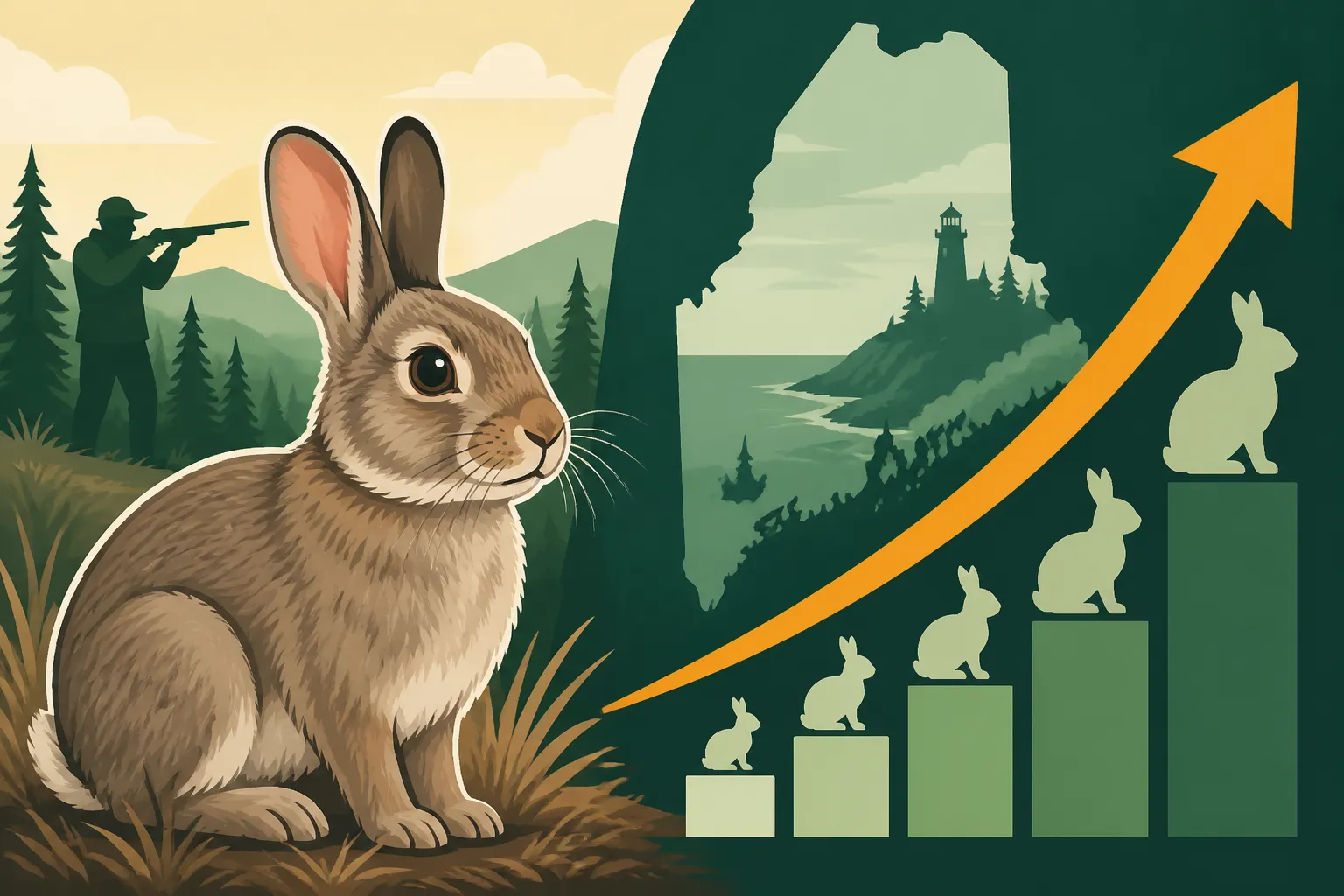
For the Eastern Cottontail, there isn't a precise statewide population count, as they're not typically managed with the same intensity as deer or moose. However, observations suggest their populations are relatively stable where suitable habitat exists, particularly in southern and central Maine. They aren't as abundant as, say, snowshoe hare in the deep woods, but they do provide consistent hunting opportunities for those who know where to look. Their resilience lies in their adaptability to various disturbed habitats, including those influenced by human activity, as long as dense cover is present.
The story for the New England Cottontail, conversely, is one of significant decline. Historically found across much of southern New England, their range has shrunk dramatically, leading to their listing as a species of concern. In Maine, they exist in scattered, isolated populations, primarily in specific southwestern counties. Intensive survey work is ongoing to identify these remaining strongholds and assess their viability. The trend here is concerning, highlighting the critical need for habitat restoration and protection efforts to prevent further losses. This is why species identification is so important for hunters; we want to ensure we're not inadvertently impacting these vulnerable populations.
Habitat Loss and Fragmentation
The biggest challenge, hands down, for both cottontail species – but especially the New England Cottontail – is habitat loss and fragmentation. Maine's landscape is constantly changing. Forests mature, development sprawls, and agricultural practices shift. All these factors contribute to the reduction of the dense, shrubby, early successional habitats that cottontails depend on. For the New England Cottontail, this is a crisis. They can't thrive in mature forests or open fields; they need that specific, dense, "messy" cover that often gets cleared for development or simply grows out into taller trees.
When patches of suitable habitat become isolated, it leads to fragmentation. This makes it harder for rabbits to move between areas, limiting genetic diversity and making populations more vulnerable to local extinctions. Imagine a rabbit needing to cross a large open field or a busy road to get from one thicket to another – it's a death trap. This fragmentation directly impacts their ability to expand their range or recover from local population dips. This isn't just a challenge for cottontails; it affects many other species that rely on young forest habitat, like ruffed grouse and woodcock. Grouse Hunting Maine Alder Runs and Woodcock Hunting Maine Covert Country delve into similar habitat needs.
Predation and Environmental Factors
Cottontails are a primary food source for a wide array of predators in Maine. Coyotes, foxes, bobcats, owls, and hawks all rely on rabbits as part of their diet. While a healthy rabbit population can sustain some predation, declining habitat can make individual rabbits more vulnerable. If they have to travel further or cross open ground to find food or mates, their exposure to predators increases dramatically.
Harsh Maine winters also play a significant role. Deep snow can cover vital food sources and make movement difficult, making rabbits more susceptible to starvation or predation. Extreme cold snaps can also take a toll, especially on younger or weaker animals. While cottontails have adapted to handle winter, prolonged severe conditions, coupled with reduced quality habitat, can push populations down. It's a natural cycle, but when combined with human-induced pressures, it can tip the scales against them.
Hunting Maine Cottontails: Strategies and Ethics
For those looking to pursue small game, cottontails offer a fast-paced, challenging hunt. However, success hinges on understanding their habits and knowing how to navigate the thick cover they call home. And, of course, doing so ethically.
Best Hunting Practices for Eastern Cottontails
Hunting Eastern Cottontails in Maine is primarily about finding the right habitat and employing patience. Since they rarely venture far from dense cover, your best bet is to focus on those brushy areas, old apple orchards, logging clearcuts with heavy regrowth, and abandoned farm fields choked with briars and saplings.
Still-hunting: This involves slowly, carefully moving through likely habitat, pausing frequently to scan for movement. Rabbits are masters of camouflage, often sitting tight until you're nearly on top of them. The key is to move at a snail's pace, often just a few steps at a time, and then stand absolutely still for several minutes, letting your eyes adjust to the patterns of the woods. Sometimes, a rabbit will bolt from under your feet, providing a quick shot opportunity. Look for fresh tracks in soft ground or snow, and droppings that indicate recent activity.
Using Beagles: Many experienced cottontail hunters swear by beagles. These dogs are purpose-bred to follow rabbit scent, pushing them out of thick cover and often in a circular pattern back towards the hunter. It's an exciting hunt, full of baying hounds and fast action. If you're considering this, remember that Maine has specific rules for Snowshoe Hare Hunting With Beagles, and many of those principles apply to cottontails as well. You'll set up on a known rabbit run or escape route, listening for the dogs to bring the rabbit around.
Walking Up/Flushing: For those without dogs, a more active approach is to systematically work through dense cover, kicking at brush piles and pushing through thickets. This often flushes rabbits, giving you a chance for a quick shot. This method can be tiring and requires rugged clothing to navigate the briars and thick stuff, but it can be highly effective in areas with good rabbit density. Always be mindful of your shooting lanes and what lies beyond your target.
Ethical Considerations and Species Identification
This cannot be stressed enough: ethical hunting of cottontails in Maine absolutely requires accurate species identification. As mentioned, the New England Cottontail is a species of concern, and it is illegal to harvest them. While they look very similar to Eastern Cottontails, responsible hunters must make every effort to avoid shooting a New England Cottontail.
Here's a rule of thumb: If you're hunting in a remote, thick, unbroken patch of dense shrubland in southwestern Maine, especially away from human disturbance or agricultural fields, there's a higher chance you might encounter a New England Cottontail. If you're hunting more common habitats like old farm edges, fencerows, or suburban fringes that still have good cover, you're almost certainly dealing with Eastern Cottontails. When in doubt, it’s always better to hold your shot. Hunters have a critical role to play in conservation, and protecting vulnerable species is paramount. Understanding Maine Small Game Season Rules is also vital before you head out.
The differences are subtle, but the New England Cottontail tends to have shorter ears and often lacks the prominent white blaze on the forehead that many Eastern Cottontails display. However, these are not foolproof indicators. The best practice is to learn the known ranges of both species and, if possible, consult resources that provide detailed identification guides.
Conservation Efforts and Hunter Involvement
The future of Maine's cottontail populations, especially the New England Cottontail, relies heavily on proactive conservation and the involvement of informed individuals, including hunters.
Protecting the New England Cottontail
Due to its precarious status, the New England Cottontail is the focus of significant conservation efforts across its remaining range, including Maine. These efforts primarily revolve around habitat restoration and creation. Wildlife biologists work with private landowners, land trusts, and state agencies to establish and maintain the dense, shrubby habitat that these rabbits absolutely need. This can involve cutting mature trees to promote new shrub growth, planting specific native shrubs, and actively managing areas to prevent them from growing into mature forest too quickly.
These projects often occur in strategic locations to create larger, connected patches of suitable habitat, addressing the problem of fragmentation. Landowners interested in helping often receive technical assistance and sometimes even financial incentives to manage their land for this species. It’s a long-term commitment, but essential for the survival of this unique native rabbit.
How Hunters Can Contribute
Hunters are often the eyes and ears of the forest, and their involvement is crucial for conservation. For cottontails, this means several things:
- Be Informed: Educate yourself on the differences between Eastern and New England Cottontails. Know their respective habitats and ranges in Maine. This knowledge is your first line of defense against accidental harvest of a protected species.
- Support Habitat Initiatives: Many state and private conservation organizations are working to create and maintain early successional habitat. By supporting these groups, through membership or volunteering, you’re directly contributing to the kind of habitat that benefits not just cottontails, but also other small game and songbirds.
- Report Sightings (Carefully): If you believe you’ve seen a New England Cottontail in an unexpected area, you can report it to the state wildlife agency. However, understand that visual identification alone is often insufficient, so be prepared to provide as much detail as possible without disturbing the animal.
- Respect Private Land and Permission: A significant portion of prime cottontail habitat is on private land. Always ask for permission before hunting. Good landowner relations are vital, and utilizing tools like GoHunt can help you understand property boundaries and landowner information for permission requests. Remember, Maine has a strong tradition of Maine's Private Land Access Tradition, but it comes with responsibilities. Knowing Do You Need Written Permission in Maine? can save you a lot of trouble.
- Consider a Mentor: For new hunters, going out with an experienced small game hunter can be invaluable for learning identification skills and effective hunting strategies. This often ensures ethical practices are passed down.
By being mindful of species, habitat, and local regulations, hunters can continue to enjoy the pursuit of Eastern Cottontails while also being a vital part of the effort to protect Maine’s native New England Cottontail and its crucial habitat. Learning how to identify Maine Squirrel and Rabbit Populations is part of being a responsible sportsman.
Here's a quick comparison of Maine's two cottontail species:
| Feature | Eastern Cottontail | New England Cottontail |
|---|---|---|
| Appearance | Generally larger, longer ears, white forehead blaze often present. Brownish-gray fur. | Slightly smaller, shorter ears, often lacks distinct forehead blaze. Similar brownish-gray fur. |
| Primary Habitat | Adaptable. Overgrown fields, fencerows, suburban edges, young forests, brush piles. | Specialist. Dense, extensive shrublands, thickets, early successional forests. |
| Status in Maine | Relatively widespread, stable where habitat exists. Regulated as small game. | Species of special concern, federally listed. Found in isolated, fragmented populations. Illegal to hunt. |
| Hunting | Legal during designated seasons with proper license. | Not permitted. Proper identification is critical. |
| Conservation | Benefits from general habitat diversity efforts. | Focus of intensive habitat restoration and protection programs. |
Disclaimer
This article is for general informational purposes only and does not constitute professional advice. Laws, prices and regulations vary by location and change over time. Consult a qualified professional for guidance on your specific situation.