Eiders on the Maine Coast
There's nothing quite like the raw, invigorating challenge of sea duck hunting on the Maine coast, and among them, the common eider reigns supreme for many waterfowlers. But let's be honest, trying to figure out where these hardy birds hang out, what gear you absolutely need, and how to stay safe and legal while chasing them can feel like navigating a minefield of regulations and local knowledge. This guide is here to break down everything you need to know about pursuing these magnificent birds, from their habits to the nitty-gritty of licenses and effective tactics, so you can hit the water with confidence.
Understanding the Maine Common Eider Population and Behavior
Eiders aren't just any duck; they're truly a creature of the sea, perfectly adapted to the rugged Atlantic coast. Understanding their life cycle, population trends, and preferred haunts is the first step to successfully hunting them here in Maine. These are tough birds, and hunting them requires a deep respect for their environment and habits.
Population Status and Trends
Maine's common eider population is generally robust, making it a premier destination for sea duck hunters. Unlike some other waterfowl species that experience significant fluctuations due to habitat loss or disease, eiders along the Atlantic Flyway have shown stable to increasing trends in recent years. This resilience is a testament to their adaptability to the harsh coastal environment and ongoing conservation efforts. When you're out there, you'll see large rafts of them bobbing in the swells, especially in the colder months. These large aggregations are a key characteristic of eider behavior and something hunters specifically look for.
However, "stable" doesn't mean "unlimited." Biologists with the U.S. Fish and Wildlife Service, in cooperation with state agencies like the Maine Department of Inland Fisheries and Wildlife (MDIFW), continually monitor eider populations through aerial surveys and banding efforts. These studies help inform season lengths and bag limits, ensuring that hunting remains sustainable. It's crucial for hunters to understand that their license fees and federal duck stamp purchases directly contribute to these vital research and habitat conservation programs, playing a direct role in maintaining healthy eider numbers for future generations.
Eider Biology and Life Cycle
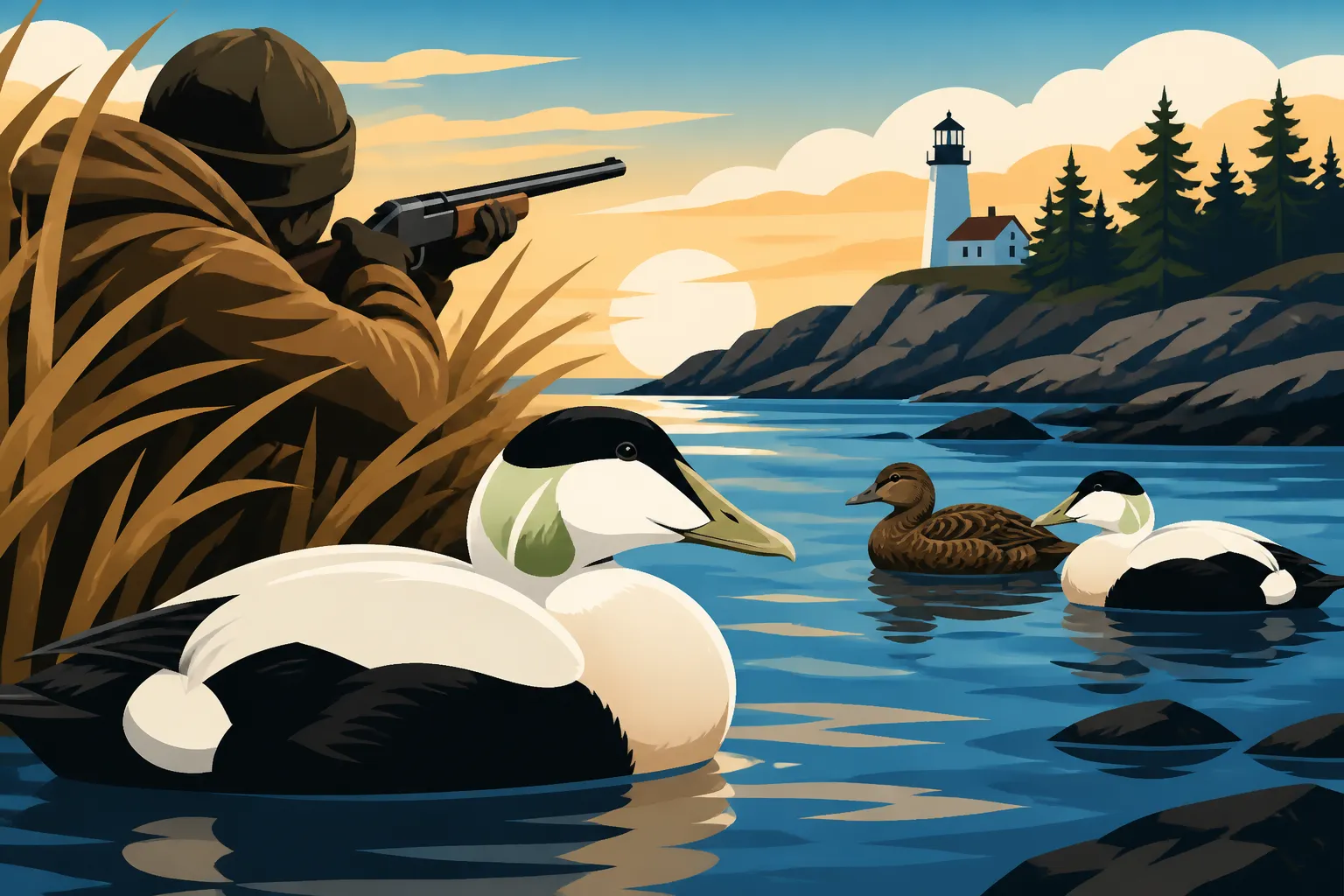
Common eiders are the largest ducks in the Northern Hemisphere, known for their distinctive wedge-shaped heads and powerful bodies. Males (drakes) are strikingly black and white with a splash of green on the nape, while females (hens) are a more camouflaged mottled brown. These birds are primarily mollusk eaters, diving to impressive depths to feed on mussels, clams, and other invertebrates attached to rocky bottoms or ledges. Their stout bills are perfectly designed for crushing shells.
Their life cycle is deeply tied to the Maine coast. Eiders begin to return to their nesting islands in early spring, with breeding occurring from April through June. They nest in dense colonies on rocky, uninhabited islands or coastal ledges, often reusing the same sites year after year. The hens are incredibly dedicated mothers, incubating their clutches for nearly a month before the ducklings hatch. These young eiders, or "creches," will often band together with multiple hens for protection as they grow quickly, learning to dive and feed in the ocean environment.
Coastal Habitat Preferences
You won't find eiders hanging out in freshwater ponds or inland marshes. Their world is the salty domain of the Atlantic. They prefer exposed coastal areas, often congregating around ledges, shoals, and rocky islands where strong currents bring abundant food sources. The deeper, colder waters offer an ideal feeding ground, and the rugged shoreline provides shelter from the fiercest storms. This is why you'll often find them far offshore, sometimes miles from the mainland, hunkered down behind an exposed rock formation.
During the late fall and winter, which aligns perfectly with Maine's sea duck hunting season, eiders tend to concentrate in large rafts, often numbering in the hundreds or even thousands. These massive flocks will move with the tides, feeding intensively at certain times and resting in protected coves or behind offshore islands during others. Knowing these preferred habitats is key, and understanding how to Reading a Ledge for a Morning Sea Duck Flight can make all the difference when scouting. This is where tools like GoHunt's mapping layers can become invaluable, helping you identify offshore structure and potential feeding grounds before you even launch your boat.
Prime Eider Hunting Grounds Along the Maine Coast
Maine's coastline is a labyrinth of islands, ledges, and rocky outcroppings, all of which can hold eiders. The trick isn't just knowing that they're there, but where specifically, and how to access those spots safely and legally. The challenge of navigating these waters and finding birds makes the reward that much sweeter.
Popular Coastal Zones and Islands
When it comes to eiders, Maine is famous for a reason. The entire coast, from Kittery up to Calais, offers opportunities, but certain areas are more renowned for consistent eider concentrations. Downeast Maine, with its myriad islands, bold headlands, and powerful tides, is often considered a hotbed. Areas around Machias Bay, Pleasant Bay, and the archipelago off Jonesport and Addison are particularly productive. Further west, islands off Muscongus Bay, Penobscot Bay, and the outer islands near Boothbay Harbor and Monhegan also host significant wintering populations.
These locations aren't just pretty scenery; they offer the specific blend of deep, current-swept waters and rocky habitat that eiders crave. Access to many of these prime spots often involves a boat launch from coastal towns like Rockland, Stonington, or Port Clyde, followed by a run out to more exposed waters. It's a humbling experience to run a boat in big water, especially in winter, and you quickly learn to respect the ocean's power. Scouting these areas involves not just looking for birds, but understanding the marine charts, identifying safe harbors, and recognizing when conditions are simply too rough to be out there.
Navigating Tidal Flats and Ledges
Eider hunting is inextricably linked to the rhythm of the tides. These birds feed heavily on mussels and other shellfish that become accessible or are concentrated in certain areas with tidal movement. This means hunters must become expert at Decoying Eiders on a Falling Tide or a rising one, depending on the specific location and the birds' feeding patterns. A falling tide, for instance, might expose mussel beds on a ledge, drawing in hundreds of birds. Conversely, a rising tide might push them into shallower feeding areas.
Navigating these tidal zones, especially around numerous ledges and rocks that disappear and reappear with the water, demands extreme caution and local knowledge. Many a prop has been lost, and many a boat grounded, by underestimating the Maine tide. It's not just about getting to your spot; it's about being able to leave it safely. Charts, GPS with detailed bathymetry, and a keen eye on current conditions are non-negotiable. Knowing the safe channels and passages, and recognizing the visual cues of currents and waves breaking over submerged hazards, is paramount.
Public vs. Private Access for Sea Ducks
Unlike inland hunting, where property lines are often clearly marked, sea duck hunting introduces a different layer of access considerations. While the water itself is generally public, many of the islands and coastal ledges that eiders use for loafing or shelter are privately owned. It's easy to assume that because you're on the ocean, you can land anywhere, but that's not the case. Understanding Maine's Sea Duck Coastal Zone Line is important, but so is respecting private property.
Before setting up shop on an island or ledge, always verify its ownership if possible. Many islands are part of the Maine Coastal Islands National Wildlife Refuge or are otherwise protected, prohibiting public access during certain times of the year, especially nesting season. Others are privately owned, and landing without permission is trespassing. While hunting from a boat in legal waters is generally fine, setting up a shore blind or deploying decoys directly from private land without permission can lead to trouble. Apps like GoHunt, with their detailed land ownership overlays, can be incredibly helpful for identifying potential conflicts before you leave the dock, helping you navigate the sometimes murky waters of coastal land access.
Essential Gear and Setup for Maine Eider Hunting
Eider hunting isn't just cold; it's brutally cold, and often wet. The right gear isn't a luxury; it's a necessity for safety, comfort, and success. Cutting corners here can lead to a miserable, even dangerous, experience. Trust me, I've seen enough shivering hunters come off the water prematurely to know that proper preparation is key.
Decoy Spreads and Placement Strategies
Eiders are highly social birds, and a large, realistic decoy spread is critical for success. Forget those small pond decoys; you'll need sturdy, oversized sea duck decoys designed to ride the waves and be visible from a distance. Many hunters opt for "super magnum" eider decoys, sometimes numbering 50 to 100 or more, to create the illusion of a massive, contented flock. These aren't cheap, but they are an investment. You'll also want a mix of drakes and hens, though many prefer a higher ratio of drakes for their stark visibility.
Placement is everything. Eiders tend to land into the wind and usually prefer to settle into the "comfort zone" of a spread, which is often just beyond the main body of decoys. A common strategy is to create a large "V" or "J" shaped spread, with the open end facing into the prevailing wind, and leaving a landing zone for birds to cup in. Often, a few "outlier" decoys, set a bit further from the main flock, can add to the realism, making it look like individuals are breaking off to feed or rest. Consider the currents as well; decoys need to ride naturally, not be swept into a jumbled mess.
Boats and Blinds for Coastal Hunting
Your boat is your lifeline when hunting eiders. It needs to be seaworthy, capable of handling choppy seas and strong currents, and reliable. Many dedicated sea duck hunters use specialized aluminum boats, often 18-24 feet, with high sides, self-bailing decks, and powerful outboard motors. Layout boats, which allow hunters to lie nearly prone at water level amidst the decoys, are also popular, especially for hunting in open water where concealment is otherwise impossible. Safety equipment, including a VHF radio, GPS, flares, and plenty of PFDs, is non-negotiable.
Concealment is also crucial. While layout boats offer inherent concealment, if you're hunting from a larger boat, you'll need an effective blind. This could be a portable blind frame draped with camo netting, or a more permanent dog house-style blind built into the boat. When hunting from shore or a ledge, brushing in a blind with local vegetation—like spruce boughs or rock—can be very effective, just make sure you're legally allowed to do so and aren't damaging sensitive habitat. The goal is to blend seamlessly into the background, making your setup appear as natural as possible to wary eiders.
Staying Warm and Safe in Harsh Conditions
This isn't your grandfather's puddle duck hunt in a warm marsh blind. Maine sea duck hunting means facing the full brunt of the Atlantic winter. Temperatures often hover around freezing, winds can be relentless, and sea spray can quickly soak you to the bone. Hypothermia is a serious, ever-present threat. Layers are your best friend: start with a good wicking base layer, add insulating layers like fleece or down, and top it all with a waterproof and windproof outer shell. Neoprene waders or a dry suit are almost essential for decoy setting and retrieval, as well as for general safety if you fall overboard.
Beyond clothing, think about hand and foot warmers, a thermos of hot coffee or soup, and even a portable propane heater for inside your blind (with proper ventilation!). Communication devices like a satellite messenger or a fully charged cell phone in a waterproof case are vital. Always let someone know your float plan, including where you're going and when you expect to return. The ocean gives no second chances, and while the thrill of the hunt is incredible, it's never worth risking your life. This is where a deep understanding of Maine Hunter Education Requirements comes into play; safety is always paramount.
Effective Eider Hunting Tactics and Strategies
Once you've got your gear and you're in the right spot, the next challenge is actually getting those eiders to commit. These are smart, resilient birds, and calling them in takes patience, observation, and a good understanding of their patterns. It's a game of chess against nature.
Reading Tides and Weather Patterns
As mentioned earlier, tides dictate eider movements. They'll feed on exposed ledges at certain tidal stages, then retreat to deeper water or loaf on calm sides of islands during others. Before you even think about setting decoys, study the tide charts for your chosen hunting area. Look for patterns: do the birds typically move in with the flood tide, or concentrate on receding waters? A falling tide, for instance, might uncover prime mussel beds, drawing birds closer to shore or to specific ledges.
Weather, especially wind, plays an equally critical role. Eiders almost always land into the wind, so your decoy spread needs to be set up to allow them to do so in front of your blind. Strong winds can also make for extremely challenging boat handling and rough seas, sometimes making a hunt impossible. Fog, a common occurrence on the Maine coast, can also shut down a hunt quickly, as visibility becomes too poor for safe navigation and shooting. Checking marine forecasts for wind speed, direction, wave height, and fog advisories is as important as checking your gun.
Calling and Shooting Techniques
While eiders aren't as vocal as some other ducks, calling can certainly help, especially to get the attention of distant birds or to reassure wary ones. Drakes emit a distinct, cooing "ooooooh" sound, which can be replicated with a specialized eider call or even by mouth for the skilled caller. Hens have a more guttural "garr-garr" call. The key isn't necessarily loud, incessant calling, but rather soft, intermittent calls that mimic a contented flock. Often, just a few well-placed calls as a flock swings by can be enough to turn them.
When eiders commit, they can approach fast and low, sometimes appearing out of nowhere over the waves. They're big birds, but also incredibly tough, so a powerful shotgun load with large shot size (like BB or BBB steel) is necessary. Don't underestimate their resilience; many a hunter has thought they've made a good shot only to watch a seemingly hit bird continue to fly. Focus on head and neck shots, and always follow up quickly. Retrieve downed birds immediately, as a wounded eider can dive and swim an astonishing distance in rough seas.
Decoying Eiders on a Falling Tide
One of the most classic and effective strategies for targeting eiders in Maine is specifically Decoying Eiders on a Falling Tide. This tactic leverages the birds' feeding habits as the water recedes, exposing their favored mussel and clam beds. As the tide goes out, these food sources become more accessible on rocky ledges and shoals. Eiders will often follow the receding waterline, diving continuously to feed.
To execute this, you'll need to identify a prominent ledge or shoal that is known to hold mussels or other shellfish. Set your decoys generously around the perimeter of this area, leaving an open landing zone into the wind. As the tide falls, the birds will naturally be drawn to the exposed or shallowing feeding grounds. Position your boat or blind upstream or upwind from the decoys, allowing the eiders to swing in over your spread. This method often works best in areas with significant tidal swings, where the exposure of these food sources creates a compelling draw for hungry birds. Be ready for fast action as the birds come in, often in groups, eager to get to the feast.
Maine's Sea Duck Season and Regulations
Hunting sea ducks in Maine, like any migratory bird hunting, comes with its own set of rules and regulations designed to ensure sustainable populations. It's not enough to just buy a license; you need to understand the specifics for Maine Sea Duck Season and Zones, daily limits, and federal requirements.
Licensing and Federal Requirements
To hunt eiders in Maine, you'll need a valid Maine hunting license. For residents, this typically involves a Maine Resident License Options, while non-residents will need a Maine Nonresident License Options. On top of that, because eiders are migratory waterfowl, you'll also need a valid federal duck stamp. This stamp is a critical piece of conservation funding, with 98% of its proceeds going directly to acquire and protect wetland habitats.
Beyond the federal duck stamp, Maine requires hunters to obtain a Maine Migratory Waterfowl Permit and complete the Harvest Information Program (HIP) survey. The HIP certification, which is usually a simple set of questions about your previous year's migratory bird hunting activity, helps wildlife agencies gather crucial data on harvest numbers across the country. Make sure all your paperwork is in order before you even head out; game wardens take migratory bird regulations very seriously, and ignorance is no excuse. Always carry proof of your licenses and stamps with you, whether physical copies or digital versions if the state allows.
Daily and Possession Limits for Eiders
Maine's sea duck regulations are structured to allow for generous opportunities while protecting bird populations. For common eiders, there is a specific daily bag limit and a possession limit. The Maine Eider Daily Limit is typically 5 drakes, but this can change, so always consult the most current MDIFW regulations. The total daily bag limit for sea ducks (eiders, scoters, long-tailed ducks combined) is typically 7 birds. However, within that 7-bird limit, there are species-specific restrictions. For example, while you can take 5 eider drakes, you might only be allowed 3 scoters or 3 long-tailed ducks as part of your overall 7-bird limit.
Possession limits are generally three times the daily bag limit, meaning you can have up to 15 eider drakes in your freezer at home, but again, always verify the most current regulations. It’s also illegal to "hen out" when hunting eiders; that is, to only shoot hens. While identification can be tough in low light or rough seas, making a conscious effort to target drakes is part of ethical hunting. Accidental hen harvests happen, but intentional hen targeting is both illegal and harmful to breeding populations.
Maine Sea Duck Zone Boundaries
Maine's sea duck season is generally open statewide, but it's important to understand the specific definitions and boundaries. The Maine Sea Duck Zone Boundaries are not as complex as some other states, typically referring to the open coastal waters and specific marine areas. For all practical purposes when hunting eiders, you'll be operating within these designated sea duck zones. These zones essentially encompass the saltwater coast from the low tide mark seaward, including bays, estuaries, and offshore islands.
It's important to remember that general duck and goose seasons, with their different bag limits and season dates, apply to inland waters and some specific tidal areas that are not designated sea duck zones. When you're out chasing eiders, you are firmly in "sea duck country." Don't confuse the two sets of regulations. While you might occasionally see other species like black ducks or mallards in coastal areas, they fall under the general duck bag limits and season dates, not the sea duck regulations. Always be able to identify your target species before you shoot.
Conservation and Sustainable Eider Hunting
As hunters, we are the original conservationists. Ethical practices, respect for the resource, and accurate reporting are crucial to ensuring healthy eider populations for the future. We all have a responsibility to contribute to the long-term sustainability of Maine's incredible sea duck hunting tradition.
Identifying Drakes vs. Hens
One of the most important aspects of ethical eider hunting, especially given the bag limit restrictions on drakes, is accurate identification. Eider drakes are easily identifiable with their striking black and white plumage, green nape, and orange bill patch. Hens, by contrast, are a mottled brown with a more subdued bill color. In bright sunlight and calm conditions, distinguishing between the two is relatively straightforward. However, in the low light of dawn or dusk, in fog, or when birds are hurtling past in rough seas, it can be much more challenging.
The importance of identifying drakes cannot be overstated. Hens are the breeding stock, and consistently removing them from the population can have a disproportionate negative impact on future generations. Make a commitment to "positive identification" before you pull the trigger. If there's any doubt, hold your fire. It's better to pass on a shot than to mistakenly harvest a hen or an out-of-season species. Practicing identification skills, perhaps with the help of a bird identification app or a good field guide, can significantly improve your ethical hunting prowess. GoHunt also offers resources that can aid in species identification through visual guides and ecological information.
Best Practices for Ethical Harvest
Beyond identifying drakes, several other best practices contribute to ethical eider hunting. First and foremost is shooting only at birds within an effective range. Eiders are tough, and attempting shots beyond 40-45 yards often leads to wounded birds that escape and eventually die, a scenario no ethical hunter wants. Practice your shooting at varying distances, using the same loads you'll use in the field, to truly understand your effective range.
Secondly, retrieve every downed bird quickly. Wounded eiders are champion divers and swimmers; they can disappear in an instant, especially in rough water. A fast, well-trained retrieving dog can be an invaluable asset, but if you're hunting without one, be prepared to get to your bird immediately. Mark the spot where it fell with a visual marker if possible. Finally, ensure proper handling of your harvest once retrieved. Clean and cool the birds quickly to preserve the meat, and respect the bird as a valuable resource. Donating venison and other game meat to local food banks, if applicable for waterfowl and properly processed, is another great way to show respect for the harvest.
The Role of Hunter Contributions to Conservation
Every time you buy a hunting license, a Maine Federal Duck Stamp Requirement, or a Maine Migratory Waterfowl Permit, you're directly contributing to conservation. These funds are crucial for habitat acquisition, wetland restoration, population monitoring, and research programs that benefit eiders and countless other wildlife species. It's a system that has worked remarkably well for over a century, funded almost entirely by hunters and anglers. Without these contributions, many of the wild places and robust wildlife populations we enjoy today simply wouldn't exist.
Beyond financial contributions, hunters also contribute through participation in surveys like the HIP program, and by reporting banded birds. If you harvest a banded eider, make sure to report the band number online or via phone. This data is incredibly valuable for biologists tracking migration patterns, survival rates, and population dynamics. Engaging in advocacy for sound wildlife management and promoting a positive image of hunting are also vital roles we play. By following regulations, being ethical, and contributing to the scientific understanding of these birds, we ensure the future of Maine's CWD-Free Cervid Herd and many other species, including the magnificent eider, for generations to come.
Disclaimer
Please remember that hunting regulations can change frequently. While this guide provides comprehensive information, it is your responsibility to consult the most current Maine Department of Inland Fisheries and Wildlife (MDIFW) regulations and federal waterfowl regulations before every hunting season. Always prioritize safety and ethical hunting practices.