Maine Common Eider Nesting Islands
If you've spent any time on the Maine coast, especially during late spring and early summer, you might have noticed the robust presence of common eiders. These striking sea ducks are a quintessential part of our coastal ecosystem, and understanding where and how they nest is crucial for anyone who appreciates our wild spaces, whether you're a hunter, a birder, or just a lover of the ocean. It can be frustrating when you want to explore the coast but don't want to accidentally disturb sensitive wildlife, and knowing the characteristics of nesting grounds is key to being a responsible visitor. This guide will walk you through the specifics of Maine's common eider nesting islands, explaining why they're so vital, what makes them suitable, and how we can all contribute to their protection.
The Importance of Maine's Coastal Islands for Common Eiders
Maine's rugged coastline, with its thousands of islands and islets, provides an indispensable sanctuary for common eiders to raise their young. These birds are truly masters of their marine environment, but when it comes to reproduction, they need specific conditions that only these isolated coastal outposts can offer.
Why Islands Are Critical for Nesting Success
Imagine being a large, somewhat awkward duck trying to raise a clutch of eggs on the mainland. You'd be constantly on high alert for foxes, raccoons, coyotes, and even domestic dogs. This is precisely why eiders have evolved to prefer islands for nesting. These islands act as natural fortresses, largely free from terrestrial predators that can decimate a nest or kill an incubating hen. The journey across open water is often enough of a deterrent for most mammals. This isn't just a slight preference; it's a critical survival strategy that dramatically increases the chances of eggs hatching and ducklings making it to the water. A successful hatch means more birds returning to our flyways, ensuring healthy populations. These safe havens are what allow robust populations of Eiders on the Maine Coast to thrive.
The isolation of these islands isn't just about predator avoidance; it also provides a sense of security and minimizes human disturbance. While some islands see recreational traffic, many of the smaller, rockier, or more remote ones are largely undisturbed. This peace allows the hens to focus on incubation without constant stress, which is vital for their health and the viability of their clutch. The sheer number and variety of islands along our coast, from Casco Bay up to Downeast Maine, offer a diverse range of suitable sites, allowing eider populations to disperse and utilize different areas as conditions change.
Historical Significance and Conservation Efforts
The story of common eiders in Maine isn't always one of thriving abundance. Like many migratory birds, they faced significant challenges in the past, particularly due to overhunting and market gunning in the 19th and early 20th centuries. Their rich down, prized for insulation, made them a target, and their eggs were often collected for food. This exploitation led to a dramatic decline in their numbers. Thankfully, with the advent of conservation laws like the Migratory Bird Treaty Act and a growing understanding of ecological principles, efforts were made to protect these birds and their nesting habitats.
Today, many of Maine's significant nesting islands are actively managed or protected by state agencies, federal wildlife refuges, or private conservation organizations like the Maine Coast Heritage Trust and the National Audubon Society. These groups work tirelessly to monitor populations, manage habitat, and educate the public on responsible coastal use. For instance, specific islands might have seasonal closures or restricted access during the nesting season to prevent disturbance. This ongoing stewardship is why we still have vibrant Maine Eider Population Trends and why Sea Duck Hunting the Maine Coast remains a sustainable tradition for many. Without these dedicated efforts, the sight of an eider duckling convoy trailing its mother would be far less common along our beautiful shore.
Identifying Key Eider Nesting Islands and Characteristics
It's not just any island that will do for a nesting eider. These birds have specific preferences, shaped by millennia of evolution, that dictate where they feel safest and most likely to succeed in raising their young. Understanding these characteristics can help us appreciate the delicate balance of their habitat and avoid accidental disturbance.
Common Traits of a Successful Eider Nesting Island
So, what makes an island a prime piece of eider real estate? It usually boils down to a few critical factors:
- Vegetation: While eiders don't nest in trees, they do seek out islands with dense, low-growing vegetation, such as thick grasses, shrubs, or even rose bushes. This provides crucial camouflage for their nests, which are typically shallow depressions on the ground, lined with their own soft down. Think of it as a natural blanket that not only insulates the eggs but also hides them from the keen eyes of gulls and crows flying overhead. The density of this cover is often more important than the specific plant species, as long as it offers concealment.
- Freshwater Access (Often Seasonal): While adult eiders are marine birds, access to freshwater can be important, especially for ducklings. Some islands have small freshwater seeps or ponds that become more prominent during wet springs. While not universally required for all nesting sites, it can be a desirable feature for brooding hens and their newly hatched ducklings before they transition entirely to the saltwater environment.
- Size and Topography: Generally, smaller, less accessible islands are preferred. The reasoning is simple: fewer terrestrial predators can reach them, and they typically see less human traffic. Rocky, uneven terrain can also offer more nooks and crannies for nests, as well as providing protection from strong winds and storm surges. An island that's too large might offer pathways for predators, while one that's too flat might be vulnerable to high tides or heavy rainfall.
- Minimal Human Disturbance: This is paramount. Islands that are frequently visited by boats, hikers, or campers are often avoided by nesting eiders. Constant foot traffic can crush nests, disturb incubating hens, and expose eggs to predators. Even well-intentioned visitors can cause stress that leads to nest abandonment. This is why you'll often find that the most productive eider nesting sites are on islands with restricted access or those managed specifically for wildlife. When you're using resources like GoHunt to scout coastal areas, it's always wise to cross-reference with local wildlife agency maps for sensitive areas or seasonal closures.
Notable Regions and Island Groups
Maine's coast offers a vast array of island habitats, but certain regions are particularly well-known for their eider nesting populations. While pinpointing exact island names might inadvertently lead to disturbance, we can discuss the general areas where these critical nesting grounds are concentrated.
- Downeast Maine: This region, stretching from Mount Desert Island eastward to Canada, is characterized by a wilder, rockier coastline and a greater abundance of uninhabited islands. The sheer isolation and ruggedness of many of these islands make them ideal. The islands here often feature dense spruce-fir forests on their interior, but the edges and exposed areas provide the low, thick vegetation eiders love. This area sees strong populations of not just eiders, but also other sea ducks like Long-Tailed Ducks Wintering Off Maine.
- Midcoast Maine: From Muscongus Bay up to Penobscot Bay, the midcoast is a mosaic of working harbors, fishing villages, and thousands of islands. While some islands are privately owned and developed, many remain wild. Conservation organizations actively manage several island groups in this region, such as those in the Muscongus and Penobscot Bays, specifically for nesting seabirds, including eiders. These islands benefit from both the remoteness of the outer islands and the protection afforded by stewardship.
- Casco Bay and Southern Maine: Closer to more populated areas, the islands in Casco Bay and farther south still host significant eider nesting activity, though often on smaller, more protected islets. These areas might be more susceptible to human disturbance, making conservation efforts and public education even more critical. Here, it’s particularly important for hunters to be aware of Maine Sea Duck Zone Boundaries and any specific regulations pertaining to sensitive areas within those zones.
Understanding these regional patterns and the specific traits of suitable islands helps us appreciate the complexity of eider conservation.
Understanding the Eider Nesting Cycle and Vulnerabilities
The life cycle of a common eider, particularly during the nesting phase, is a remarkable feat of natural resilience, but it's also a period of immense vulnerability. Knowing this cycle helps us understand why responsible behavior around coastal islands is so critical.
The Nesting Season Timeline and Behavior
The eider nesting season in Maine is a fairly predictable, though weather-dependent, affair:
- Arrival and Pair Bonding (Late Winter/Early Spring): Eiders, many of whom have spent the winter along the Maine coast, begin to pair up in late winter and early spring. The males, with their striking black and white plumage, perform elaborate courtship displays to attract females.
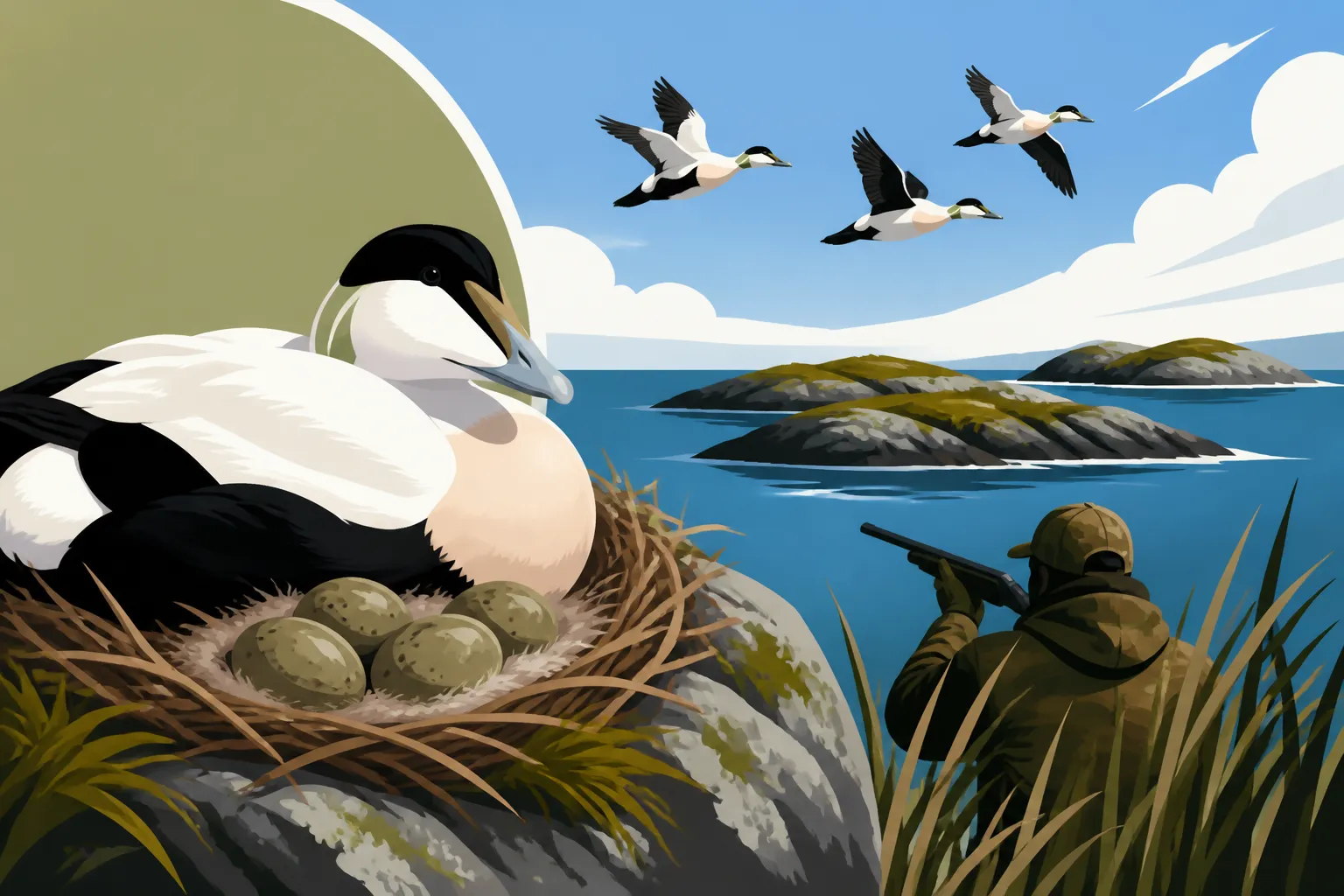
- Nest Building and Egg Laying (Late April to June): By late April and into May, hens begin to choose their nesting sites on preferred islands. They'll create a shallow scrape in the ground, often tucked under dense vegetation or among rocks. This nest is meticulously lined with twigs, grass, and most famously, down feathers plucked from the hen's own breast. These feathers are not just for comfort; they provide incredible insulation for the eggs. A typical clutch ranges from 4 to 6 eggs, though sometimes more. Each egg is laid a day or two apart, and incubation usually begins once the full clutch is laid.
- Incubation (Late May to Mid-July): The hen incubates the eggs for approximately 25-28 days. This is a demanding period, as she rarely leaves the nest, sometimes going for days without food or water, relying on her fat reserves. Her dedication is absolute, often remaining on the nest even when approached by potential threats.
- Hatching and Brooding (June to July): Once the ducklings hatch, they are precocial, meaning they are relatively mature and mobile shortly after birth. Within a day or two, the hen leads her brood to the water. These "eider rafts" or "creches" are a common sight, where multiple hens might join forces, pooling their ducklings into one large group, providing collective defense against predators like gulls and even larger fish. This period from egg laying to ducklings taking to the water is the most critical for their survival. If you're out hunting the Maine coast for other species or just exploring, be mindful that these birds are going through a vital part of their life cycle.
| Stage of Nesting Cycle | Approximate Timeframe (Maine) | Key Behaviors | Vulnerabilities |
|---|---|---|---|
| Pair Bonding | February – April | Courtship, territory establishment | Minimal |
| Nest Building | Late April – Mid-May | Site selection, down plucking, nest creation | Human disturbance, late storms |
| Egg Laying | May | 1-2 eggs per day (4-6 total clutch) | Nest predation, disturbance |
| Incubation | Late May – Mid-July | Hen sits tight on nest, rarely leaves | Hen predation, nest abandonment, human disturbance, severe weather |
| Hatching | June – July | Ducklings emerge, led to water quickly | Duckling predation, cold, human disturbance |
| Brooding | July – August | Multiple hens may form "creches" | Duckling predation, disease |
Threats to Nesting Eiders Beyond Predation
While terrestrial predators are a major reason eiders choose islands, other threats loom large during the nesting season:
- Human Disturbance: This is perhaps the most significant and often overlooked threat. Unaware boaters landing on nesting islands, curious hikers getting too close to nests, or even loud noises can cause a hen to flush from her nest. A flushed hen exposes her eggs to opportunistic avian predators like gulls and crows, which can devour a clutch in minutes. Repeated disturbance can lead to nest abandonment, dooming the entire clutch. Even collecting shed feathers or moving debris on a nesting island can have unintended negative consequences. Always check local regulations, and consider using tools like GoHunt for up-to-date access information before heading out to coastal areas.
- Severe Weather: Coastal Maine weather can be unpredictable. Late spring storms with heavy rains and high tides can flood nests, especially those too close to the waterline. Prolonged cold spells can also be detrimental to eggs and newly hatched ducklings. While eiders are incredibly hardy, extreme weather events, which may be increasing in frequency, pose a genuine threat.
- Disease and Contaminants: Like all wildlife, eiders are susceptible to various diseases, and large concentrations of nesting birds can sometimes see outbreaks. Additionally, environmental contaminants, such as oil spills or persistent pollutants in their marine diet, can impact their reproductive success and overall health. A healthy marine ecosystem is fundamental to healthy eider populations.
- Avian Predation: Even on islands, eider nests and ducklings are vulnerable to aerial predators. Gulls, especially Greater Black-backed Gulls and Herring Gulls, are notorious nest predators, as are crows and ravens. These birds are always on the lookout for an exposed egg or a vulnerable duckling. This constant threat is why camouflage and a dedicated incubating hen are so vital.
Understanding these vulnerabilities underscores the importance of every effort we make to protect these remarkable birds and their nesting habitats.
How Hunters Can Be Good Stewards of Eider Nesting Habitat
As hunters, we often pride ourselves on being conservationists, and extending that stewardship to critical nesting habitats for species like the common eider is a natural extension of that ethic. Many of us enjoy Decoying Eiders Off the Maine Coast in the fall and winter, and ensuring their breeding success directly impacts future hunting opportunities. Our actions, or inactions, can have a profound impact.
Minimizing Disturbance During Critical Periods
The most impactful thing any coastal visitor, including hunters, can do is to simply stay away from known or suspected nesting islands during the critical nesting and brooding periods, roughly from May through July.
- Know Before You Go: Before you embark on any coastal trip, whether for fishing, recreation, or scouting for the upcoming sea duck season, take a moment to research the areas you plan to visit. Many state and federal agencies, as well as conservation organizations, clearly mark or list islands that are sensitive nesting sites. While specific island names might not always be publicized to prevent deliberate disturbance, general areas of concern are often highlighted. Tools like GoHunt can sometimes provide overlay maps or regulatory information that helps identify sensitive zones.
- Observe Posted Closures: It cannot be stressed enough: if an island is posted with signs indicating seasonal closures or restricted access for nesting wildlife, respect those signs without question. These restrictions are put in place for a vital reason, and ignoring them can have dire consequences for the birds.
- Maintain Distance: Even if an island isn't explicitly closed, if you observe signs of nesting activity—such as flushed birds, agitated parent birds, or groups of ducklings—maintain a respectful distance. Use binoculars to observe from afar rather than approaching. A good rule of thumb is if your presence changes the behavior of the wildlife, you're too close.
- Leave No Trace: If you absolutely must land on an island (outside of nesting season, of course), practice strict Leave No Trace principles. Pack out everything you pack in, and avoid disturbing vegetation or creating new trails. This helps preserve the natural integrity of the habitat for future nesting cycles.
Supporting Conservation Initiatives
Beyond direct actions, hunters and outdoor enthusiasts can play a proactive role in supporting the broader conservation of eider nesting habitats.
- Support Conservation Organizations: Many non-profit organizations are on the front lines of seabird conservation in Maine. Groups like Maine Audubon, Maine Coast Heritage Trust, and local land trusts do critical work protecting and managing nesting islands. Membership fees, donations, or volunteering your time can directly contribute to these efforts. Remember, a thriving population of Eiders on the Maine Coast is a direct result of these efforts.
- Report Violations: If you witness someone disturbing nesting birds, disregarding posted closures, or engaging in any activity that appears to harm wildlife or their habitat, report it to the appropriate authorities. The Maine Warden Service and other law enforcement agencies rely on vigilant citizens to help protect our natural resources. Knowing how to use resources like GoHunt to quickly look up contact information for local wildlife agencies on your phone can be incredibly helpful in such situations.
- Advocate for Habitat Protection: Stay informed about policy decisions that could impact coastal habitats. Participate in public comment periods, write to your representatives, or join advocacy groups that champion conservation measures. The long-term health of our eider populations depends on ongoing habitat protection and management.
- Educate Others: Share your knowledge with fellow hunters, boaters, and outdoor enthusiasts. Many people simply aren't aware of the sensitive nature of nesting islands or the impact their presence can have. A friendly conversation about responsible coastal etiquette can go a long way in fostering a culture of respect for wildlife. We all share this incredible resource, and collective awareness is our strongest tool for preserving it for generations to come. This commitment to responsible practices helps ensure that Maine's Place on the Atlantic Flyway remains strong and vibrant for all migratory birds.
By being mindful, respectful, and proactive, Maine hunters can continue to be leaders in conservation, ensuring that common eiders have the safe havens they need to thrive along our beloved coast.
Disclaimer
This article is for general informational purposes only and does not constitute professional advice. Laws, prices and regulations vary by location and change over time. Consult a qualified professional for guidance on your specific situation.