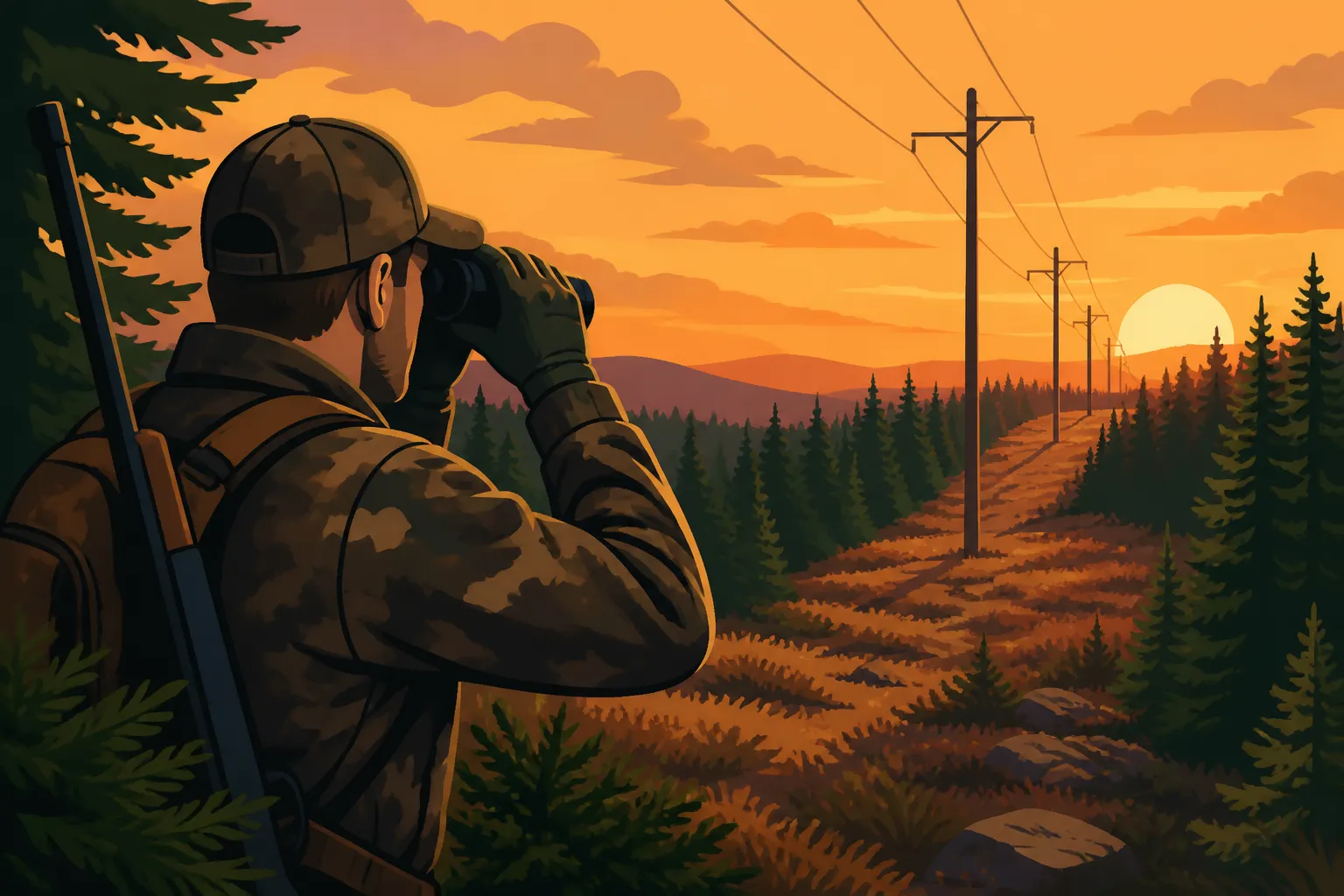
Glassing a Powerline Cut at Last Light
There’s a unique frustration that comes with hunting Maine’s whitetails, especially when the sun starts to dip below the horizon, painting the sky in fiery oranges and purples. You’ve sat patiently, the chill seeping into your bones, only for a phantom buck to ghost through a clearing right at last light, just out of range or in heavy shadow. Powerline cuts, with their vast openness and dense edges, are notorious for these fleeting glimpses, making them a high-reward, high-challenge spot. This guide is all about equipping you with the strategies and mindset to effectively glass these tricky powerline cuts during that magical, yet maddening, last hour of daylight, turning those phantom sightings into real opportunities.
Why Powerline Cuts Are Deer Magnets at Last Light
Powerline cuts aren't just scars on the landscape; they're dynamic habitats that deer exploit to their advantage, especially as the day winds down. Understanding why they use these areas is the first step to figuring out how to hunt them. It's not just random chance you see deer here; it's calculated behavior based on resources and security.
Food and Cover in the Open
Think about a powerline cut: it’s essentially a linear clear-cut, constantly being maintained to keep tall trees from interfering with the lines. This perpetual disturbance creates a fantastic environment for young, tender browse. We're talking about saplings, brush, wild berries, and various forbs that thrive with abundant sunlight. Deer, being browsers, are drawn to these buffet lines, especially when the mature timber around the cut might be lacking in diverse forage.
As darkness approaches, deer feel more secure moving into these slightly more exposed areas to grab a quick meal before bedding down for the night or after getting up from their afternoon beds. The edges of these cuts, where the mature forest meets the brushy clearing, offer that perfect blend of security and sustenance. They can stand just inside the cover, munching away, while still being able to dart back into the thick woods at the first sign of danger. This often creates natural travel corridors right along the timberline. If you spend some time looking, you'll often find a distinct travel way just inside the woods line that runs parallel to the opening.
Transition Zones and Travel Corridors
Deer are creatures of habit and efficiency. Powerline cuts often serve as natural highways or transition zones between different types of habitat. Imagine a deer bedding down deep in a cedar swamp or a thick stand of spruce. Their evening destination might be a distant oak ridge or an agricultural field. A powerline cut might offer the path of least resistance, a direct route through varying terrain without having to navigate dense undergrowth or steep inclines.
During that last hour of light, deer are actively moving from their daytime bedding areas to their nighttime feeding spots. A powerline cut provides both the food (as mentioned above) and a relatively easy travel path. They might pop out of the woods, browse a bit, then continue their journey across the open section to another patch of woods, or simply work their way down the cut itself. This makes glassing critical; you're not just looking for deer feeding, but for deer moving. They could be anywhere along that long, linear opening, or just on its edges, using the shadows to their advantage. Understanding Where Maine Bucks Bed in Big Timber can give you a better idea of where they might be coming from.
Essential Gear for Effective Last Light Glassing
Effective glassing isn't just about having a pair of binoculars; it's about having the right tools and knowing how to use them to penetrate the shadows and pick apart the landscape. When legal shooting light is fading, every advantage counts.
Quality Optics and Stability
This is non-negotiable. You need good glass – binoculars, and ideally, a spotting scope. For binoculars, a 10×42 or 10×50 power is a great all-around choice. They offer a good balance of magnification, light gathering, and field of view. However, for those long, sprawling powerline cuts, especially if you're trying to pick out a horizontal line that is a deer's back in a vertical forest of saplings, a spotting scope becomes your best friend. A 15-45x or 20-60x scope can bring distant objects into sharp focus, allowing you to discern antler tines from branches, or a subtle ear twitch from a leaf.
But here’s the kicker: none of that amazing glass is worth a darn if it's not stable. Handheld binoculars will give you shaky images, especially as your arms tire. A tripod is absolutely essential for both binoculars (with an adapter) and a spotting scope. It allows for steady, deliberate scanning, reducing eye fatigue and greatly increasing your ability to spot subtle movement or details. You want a tripod that's sturdy but not overly heavy, and one that allows for smooth panning and tilting. For optimal performance, check out brands like Vortex Optics or Maven Optics, known for their clarity and durability in the field. Don't forget a good laser rangefinder to confirm distances once you spot something interesting; judging distances accurately in fading light can be deceptive.
Comfort, Camouflage, and Scent Control
You’re going to be sitting still for a while, probably in a position where you have a wide view of the powerline. Comfort is key to patience. Bring a small, portable hunting chair or a thick cushion. Staying comfortable means you’re less likely to shift, fidget, and potentially spook an approaching deer. Layered clothing is also critical for Maine's unpredictable evenings. Even if it starts warm, the temperature can drop quickly at last light, and shivering isn't conducive to steady glassing.
Camouflage, particularly patterns designed to break up your silhouette against mixed timber, is important, but often overlooked is the background you choose for your vantage point. Don't sit sky-lined on a ridge. Position yourself against a dark backdrop like a stand of pines or a large rock face to help you disappear.
Finally, scent control. Even if you're a good distance from where deer might appear, wind shifts can carry your scent. Deer have incredible noses, and a whiff of human odor will send them packing faster than a gunshot. Play the wind, always. Check the wind direction before you even pick your glassing spot, and if it shifts, be ready to adjust your position if possible. A good mapping app can also help you understand how Wind and Thermals in Maine Hill Country might affect scent dispersal in your chosen location.
Here's a quick comparison of popular binocular magnification levels for various hunting scenarios:
| Magnification | Objective Lens (mm) | Best Use Case | Pros | Cons |
|---|---|---|---|---|
| 8x | 32 or 42 | Dense woods, closer range, fast action | Wider field of view, brighter, steady | Lower magnification for long distances |
| 10x | 42 or 50 | All-around hunting, mixed terrain | Good balance, ample light, versatile | Can be shaky handheld without practice |
| 12x | 50 or 56 | Open country, long-range glassing | Higher detail at distance | Narrower field of view, heavier, needs tripod |
| 15x | 50 or 56 | Western hunting, extreme long range | Max magnification for binoculars | Very heavy, absolutely requires tripod |
Strategic Approaches to Glassing a Powerline Cut
Glassing effectively is more than just staring through optics; it's a systematic approach to breaking down a vast area and identifying anomalies. Especially at last light, when shadows play tricks on your eyes, a disciplined strategy will pay dividends.
Optimal Positioning and Angle of Attack
Before you even set up your tripod, take a moment to evaluate the powerline cut. You need to find a vantage point that gives you the best possible view while keeping you concealed. Often, this means getting slightly elevated. A small knoll, a rock outcrop, or even the edge of a slight ridge can give you an advantage, allowing you to see over low brush or terrain features that would hide a deer at eye level.
Crucially, consider the sun's position. As the sun sets, you want it at your back, if possible, to illuminate the opposite side of the cut and reduce glare in your optics. If the sun is directly in your eyes, you're essentially hunting blind. Also, think about the wind. A good rule of thumb is to set up so the wind is blowing across you or directly into your face, never at your back, pushing your scent into the area you're watching. This isn't always possible in Maine's varied topography, but it should be your primary consideration.
Don't just pick the first spot you find. Walk a bit, use a good mapping app to scout potential vantage points. Applications like GoHunt provide detailed topographic maps and aerial imagery that can reveal hidden benches, slight elevations, and potential travel corridors where deer might emerge. Knowing these details before you step foot in the woods can save you hours of unproductive glassing.
The Grid Method: Slow and Steady Wins the Race
Once you’re set up, resist the urge to just randomly scan the entire powerline cut. This is a recipe for missing deer. Instead, employ the "grid method." Start at one end of the cut, pick a specific section (say, a 50-yard wide strip), and begin scanning from left to right, slowly. Once you reach the end of that strip, drop your optics down slightly and scan back from right to left. Repeat this process, working your way methodically across the entire cut, from the nearest edge to the furthest point you can effectively see.
The key here is patience and deliberation. Don't rush. Pause and examine any "out of place" anomaly. You're not necessarily looking for a whole deer. Often, you'll spot just a part: a horizontal line that shouldn't be there, the flick of an ear, a patch of hide, a reflection in an eye. Deer are masters of camouflage, especially in the low light. They know how to blend. Your job is to look for something that doesn't blend. This is where a stable tripod and quality glass really shine, allowing you to hold steady on a suspicious patch of cover until your brain processes what you’re seeing. Remember, it's often the lack of movement and the slight shape anomaly that gives them away.
Reading the Sign and Maximizing Your Chances
Glassing at last light isn't a standalone tactic; it's often the culmination of prior scouting and an understanding of deer behavior. By combining what you see on the ground with what you see through your glass, you significantly increase your odds.
Interpreting Deer Sign Along the Edges
Even if you're not seeing deer during the day, the powerline cut and its immediate surroundings are full of clues. Before you settle in for your last-light session, spend some time walking the edges of the cut. Look for fresh deer sign: tracks in soft earth, heavily used trails entering and exiting the cut, rubs on small saplings, and fresh scrapes. Pay particular attention to where these trails intersect or parallel the powerline. These are often indicators of preferred entry and exit points for deer moving between bedding and feeding areas.
Focus on topographical features that might funnel deer movement. A small saddle in a ridge that crosses the powerline, a narrow neck of woods between two open areas, or even a low point in a fence line can act as a natural pinch point. Deer, being creatures of efficiency, will use these easy travel routes. If you find heavy sign in such a funnel, it tells you that deer are using this particular section of the powerline cut, making it a prime candidate for your last-light glassing efforts. A comprehensive map on GoHunt can help you identify these subtle terrain features that might concentrate deer movement, even on seemingly flat ground. Knowing how to Read Maine Mud for Fresh Deer Movement can give you an edge here.
Understanding Deer Movement in Fading Light
Deer activity often peaks during dawn and dusk, but at last light, it's a specific kind of movement. They're usually moving with a purpose: to a primary feeding area, to water, or to their nighttime bedding. Their cautiousness increases as the light fades, often making them more prone to staying just inside the shadows or appearing for only brief moments.
This means you need to be prepared to act quickly if you spot a deer worth pursuing. Have your rifle or bow ready. Practice getting your weapon up smoothly and quietly, acquiring your target, and making the shot. In the low light, every second counts. Don't be afraid to take your eyes off your optics for a moment to scan the immediate area with your naked eye, particularly if you hear a rustle. Sometimes, a deer will appear much closer than you expect, having approached silently along the timberline. It’s a dance between patience and readiness. Consider the fact that Late-Season Food Sources for Maine Whitetails might also influence where deer emerge, as their patterns shift with the available forage. If you've done your homework and found an area with abundant late-season browse in or around the powerline, your chances increase significantly.
Ultimately, glassing a powerline cut at last light is a test of patience, discipline, and preparation. It's about combining your gear, strategy, and knowledge of deer behavior to make the most of those precious, fleeting minutes before darkness completely claims the woods.
Disclaimer
Please ensure you are familiar with and adhere to all current Maine hunting laws and regulations regarding hunting hours, legal methods, and firearm safety. Always prioritize safety for yourself and others in the field. This guide is for informational purposes only and does not replace official state hunting regulations.