Hunting a Clear-Cut Regrowth Edge
Trying to find where deer go after a logging operation can feel like a real head-scratcher. One minute you're hunting familiar timber, the next it's a tangled mess of stumps and slash, leaving you wondering if the deer simply vanished. But here in Maine, these clear-cut regrowth edges are actually some of the most overlooked and productive spots for whitetails, offering both critical food and dense cover. This guide will walk you through exactly how to decipher these evolving landscapes and successfully hunt the edges where deer thrive.
Understanding Clear-Cuts and Regrowth in Maine
When you see a large section of forest that's been clear-cut, it might look like a wasteland at first glance. However, for a deer, it's often an all-you-can-eat buffet and a secure bedroom, especially as it moves through different stages of regrowth. Understanding this cycle is key to unlocking the hunting potential of these areas.
What is a Clear-Cut and Why is it Productive?
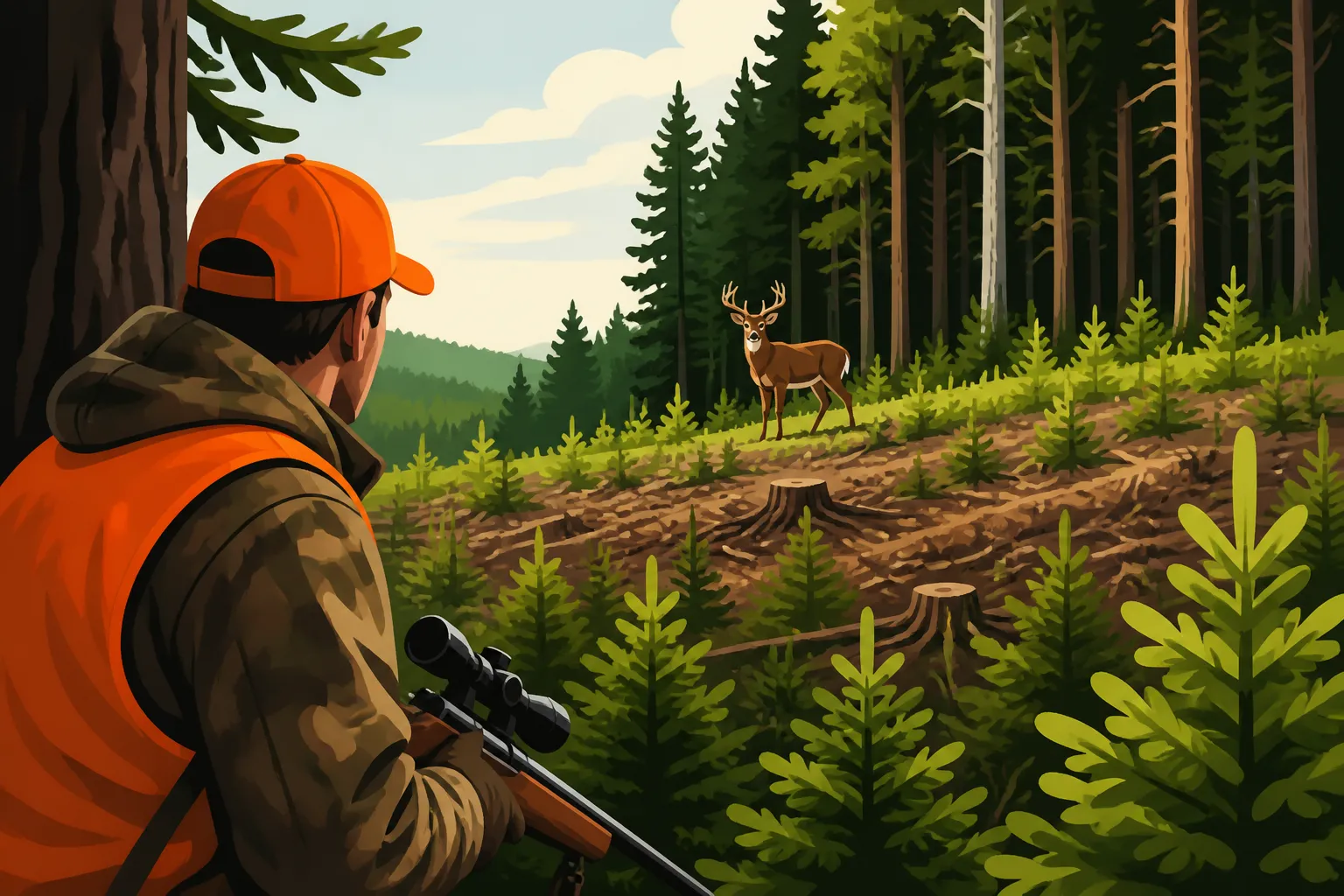
A clear-cut, in simplest terms, is an area where most or all of the trees have been harvested. It might be done for timber production, forest health, or a combination of factors. While some might see it as destructive, it's actually a natural part of forest ecology that mimics disturbances like wildfires or severe wind events. After the heavy machinery leaves, the sun, which was once blocked by the dense canopy, now reaches the forest floor. This sudden influx of light triggers an explosion of new growth.
Think about it: mature, closed-canopy forests, while beautiful, don't offer much in the way of browse for deer down low. The good stuff is usually too high up. But in a clear-cut, sunlight hitting the ground encourages a rapid flush of early successional plants – grasses, wildflowers, tender shoots, and tiny saplings of hardwood species like maple, birch, and aspen. These are incredibly high in nutrition and easily accessible for deer. This transformation from a shaded, low-nutrient environment to a sun-drenched, nutrient-rich one is why clear-cuts quickly become magnets for whitetails, providing both critical forage and excellent thermal cover.
The Stages of Regrowth and Deer Preference
The clear-cut isn't a static environment; it’s a living, breathing landscape that changes dramatically over time. Deer will utilize these areas differently depending on the stage of regrowth.
- Year 1-3 (Early Successional): This is the "salad bar" phase. Immediately after a cut, you'll see an explosion of herbaceous growth, wild raspberries, blackberry canes, and small tree seedlings. Deer will gorge on these tender plants. The cover isn't super dense yet, but the sheer amount of food draws them in. During this stage, deer might feel exposed in the middle of a cut, so they'll often feed heavily along the very edge, darting back into mature timber for security.
- Year 4-7 (Dense Thicket): This is where it gets really interesting for hunters. The tree seedlings and brush have grown into a dense, almost impenetrable thicket. This creates incredible bedding cover, escape routes, and thermal protection from harsh Maine winters. Deer will spend a lot of time inside these dense regrowth areas, using the edges primarily for travel and feeding during low-light hours. Hunting this stage often means focusing on the transition zones, bottlenecks, and subtle trails leading in and out of the thick stuff. You might find more rubbing and scraping activity along these defined travel corridors.
- Year 8-15+ (Developing Forest): As the regrowth matures, some trees start to outcompete others, forming a young forest. The understory might become less dense as the canopy begins to close in. Deer will still use these areas, especially if there are still pockets of dense cover or desirable food, but they might shift their core activity to newer cuts or different habitats. This stage can still be great for hunting, but it requires a keen eye for subtle deer trails and changes in vegetation.
Here’s a quick overview of how deer use clear-cut regrowth over time:
| Regrowth Stage | Primary Deer Use | Hunting Challenge | Key Focus for Hunters |
|---|---|---|---|
| Year 1-3 | Heavy feeding, transitional cover | Limited dense cover | Edges, adjacent mature timber, entry/exit points |
| Year 4-7 | Bedding, escape cover, security, some feeding | Extremely dense, difficult to navigate | Pinch points, defined trails, transition zones |
| Year 8-15+ | Travel, secondary feeding/bedding, mast crops | Understory thinning | Mature trees, browse pockets, travel corridors within |
Scouting and Locating Deer in Clear-Cut Edges
Okay, you know what a clear-cut is and how deer use it. Now, how do you actually find the deer? This isn't about aimlessly wandering; it's about focused observation and understanding how deer move through these complex environments.
Interpreting Sign Along the Edge
Deer sign is everywhere in a clear-cut edge, but you have to know what you're looking for and, more importantly, why it's there. The edges are the highways and rest stops for deer traveling between the secure bedding of the dense regrowth and the feeding areas, or mature timber.
Start by looking for fresh tracks. Are they consistently moving in and out of the regrowth? Are there specific trails that are more worn than others? Pay close attention to where these trails intersect older timber, stream crossings, or changes in topography. These are your "pinch points." Droppings can tell you about recent activity and diet. A pile of fresh, dark pellets indicates recent feeding and resting.
Rubs and scrapes are particularly exciting to find, especially during the pre-rut and rut. Bucks will often make rubs on saplings along the edges of clear-cuts as they move through, marking their territory. Scrapes, particularly primary scrapes with an overhanging licking branch, indicate a buck frequently visiting that spot. If you find a series of scrapes along a clear-cut edge, you've likely found a major travel corridor. Remember that deer feel more secure moving at the edge of thick cover, so these signs will be concentrated there. A tool like the GoHunt app or onX Layers for Maine Land Status can be incredibly helpful here, allowing you to overlay satellite imagery with topo maps to identify these transition zones and potential funnels even before you step foot in the woods. By using these layers, you can often pinpoint subtle terrain features or even old logging roads that might act as natural travel routes on the edge of a clear-cut.
Using Wind and Thermals in Regrowth
Hunting clear-cuts, especially their edges, means thinking differently about wind and thermals. In dense, mature timber, the canopy can act as a bit of a buffer, keeping ground-level winds more consistent. But in a clear-cut, that canopy is gone. Wind currents can be swirling, unpredictable, and often more intense, making it a real challenge to stay undetected.
When scouting, always pay attention to the prevailing wind, but also consider micro-thermals. In Maine's varied terrain, even subtle elevation changes around a clear-cut can create thermal drafts. As the ground warms up after sunrise, air rises, creating an uphill thermal. Conversely, as it cools in the evening, air sinks, creating a downhill thermal. This means that a clear-cut on a hillside will have different air currents in the morning than in the evening. Deer use these thermals to their advantage, often bedding high and moving down to feed in the evenings, or vice-versa.
Your strategy for setting up must incorporate this. You want the wind and thermals to carry your scent away from where you expect deer to approach or be bedding. If you’re hunting a clear-cut edge that slopes down to a field, for example, an evening hunt might involve sitting high, letting your scent drift down and away from the deer moving uphill to feed. Conversely, for a morning hunt, you might want to be lower, letting your scent rise and dissipate. Wind and Thermals in Maine Hill Country offers even more specific insights into this often-overlooked aspect of deer hunting. Always carry a wind checker, like a small bottle of powder or a milkweed pod, and use it frequently to understand the ever-changing air currents around a clear-cut.
Hunting Strategies for Clear-Cut Regrowth Edges
Once you've done your scouting and have a good understanding of the clear-cut, it's time to choose your hunting method. These areas lend themselves to a variety of tactics, from static stand hunting to more active approaches.
Stand Placement and Ground Blind Tactics
For many Maine hunters, a tree stand is the go-to. When hunting a clear-cut edge, placement is paramount. You want to be positioned where you can intercept deer as they transition between the heavy cover of the regrowth and an adjacent food source or travel corridor, all while maintaining good shooting lanes. Look for mature trees that provide adequate cover to break up your silhouette, situated directly on or just inside the edge of the clear-cut. Consider setting up in a funnel where two clear-cut edges converge, or where a clear-cut meets a natural barrier like a stream or rock wall. This forces deer movement into a more predictable path.
Think about your Hanging a Stand on a Private Land Field Edge, but apply that same principle to the clear-cut: get high enough to see over some of the initial regrowth and allow for a good shot angle, but not so high that you silhouette yourself against the skyline. Use pruning shears to clear shooting lanes before the season, being mindful not to create a tunnel that screams "hunter!" Remember, deer in clear-cuts are often acutely aware of their surroundings due to the open nature, so stealth is key.
Ground blinds are another fantastic option, especially in areas where suitable trees for stands are scarce or if you need to be mobile. A pop-up ground blind can be brushed in along the clear-cut edge, providing excellent concealment. You can also create a natural ground blind by utilizing fallen logs, rock outcroppings, or thick evergreen clumps that border the regrowth. When using a ground blind, ensure you have multiple shooting lanes and that your entry and exit routes are concealed. For detailed tips on this, check out Using a Ground Blind on Posted-Free Land. The goal is to blend seamlessly into the edge, becoming another part of the natural landscape.
Still-Hunting and Drives Around Regrowth
Still-hunting is perhaps one of the most effective, yet challenging, ways to hunt clear-cut edges. It requires immense patience, slow movement, and keen observation. The idea is to move slowly, taking only a few steps at a time, then stopping for several minutes to scan for deer. Use your binoculars constantly to pick apart the dense regrowth, looking for horizontal lines (a deer's back) in a vertical world, or the flick of an ear.
Focus on moving into the wind or with a crosswind, hugging the clear-cut edge. Pay close attention to subtle deer trails leading into the dense stuff. These are likely routes deer use to bed down. Early morning, when deer might still be feeding along the edge, or late afternoon, as they begin to stir for evening activity, are prime times for still-hunting. The key is to be as silent as possible, using natural contours and cover to your advantage.
If the regrowth is particularly vast and dense, and you have a small group, a carefully planned deer drive can be effective. Deer Drives With Three or Four Hunters can be adapted for clear-cuts, with hunters strategically placed along the edge to catch deer pushed out of the thick cover. One or two "drivers" would slowly push through the densest parts, making noise and encouraging deer to move. Safety is paramount during a drive; clearly communicate positions and shooting zones beforehand, and always wear plenty of blaze orange. This method is best reserved for vast, challenging clear-cuts where still-hunting becomes too difficult due to the sheer density.
Calling and Decoy Strategies
Don't underestimate the power of calling when hunting clear-cut regrowth edges, especially during the peak of Hunting the Rut in Early November. The thick cover provides security, making bucks feel bolder as they search for does. Grunt calls can be very effective in these environments. A deep grunt can pique a buck's curiosity, making him believe another buck is with a hot doe in the dense cover. Follow up with a few estrous bleats, and you might just pull a cruising buck right to the edge of the clear-cut.
Rattling can also work wonders. The sound of antlers clashing carries well, especially in the more open areas of a clear-cut, drawing in curious bucks who want to investigate a fight. When rattling in thick spruce or fir regrowth that often borders clear-cuts in Maine, remember to adjust your volume. Too loud, and you might scare them off; too soft, and it won't carry. For specific tips on modulating your calls, read Rattling Volume in Thick Spruce Cover. The key is to sound natural and to position yourself with the wind in your favor, ready for a deer to sneak in downwind to scent-check the situation.
Decoys are a bit trickier in dense regrowth. While a single doe decoy can sometimes draw in a buck, the visibility challenges in a clear-cut might limit its effectiveness. If you do use one, place it on a visible path just inside the edge, quartering away to present an inviting posture for an approaching buck.
Gear and Considerations for Clear-Cut Hunting
Hunting clear-cuts presents unique challenges, and having the right gear can make or break your experience, ensuring both comfort and safety.
Essential Gear for Navigating and Hunting Clear-Cuts
First and foremost, footwear is critical. Clear-cuts are often wet, muddy, and full of sharp debris. Durable, waterproof boots with good ankle support are non-negotiable. Think something robust like a high-quality leather or rubber boot from brands known for their rugged outdoor gear.
Next, clothing. Layers are your friend. You'll be working hard, pushing through brush, which can lead to overheating, but then sitting still, where you'll get cold fast. Choose quiet, durable fabrics that can withstand snags and tears. Always, always wear enough blaze orange. Maine's regulations are strict, and for good reason: these areas can be dense, and visibility is key for safety. This is especially true during the firearms season where Maine Blaze Orange Requirements mean you need to be seen.
Navigation tools are absolutely essential. Clear-cuts can be disorienting, with trails that suddenly end and landmarks that disappear behind new growth. A reliable GPS unit or a smartphone with mapping apps like GoHunt or onX Hunt is vital. Download offline maps before you head out, as cell service is often spotty in these remote areas. Having a compass and knowing how to use it as a backup is always a smart move. When you're in the woods, it's easy to lose track of where you are, so periodically checking your position is good practice.
Finally, consider game retrieval tools. If you successfully harvest a deer in a clear-cut, getting it out can be a monumental task. A game cart can be invaluable if the terrain allows, but often a sturdy rope, a good knife, and a solid plan with hunting partners is your best bet. A small saw might also come in handy for clearing brush if you need to create a path for dragging.
Safety and Ethical Hunting in Regrowth
Hunting clear-cut regrowth edges demands a heightened sense of safety and ethical responsibility. Visibility is often poor, and the dense cover can make it difficult to identify your target and what lies beyond.
Always be absolutely certain of your target. In thick cover, it's easy to mistake movement or a flash of brown for a deer. Take your time, use binoculars, and only take a shot when you have a clear, ethical shot at a legal animal. Never shoot at sound or movement.
Know your surroundings. Be aware of other hunters, especially if you're on public land. The density of clear-cuts can mask sounds and lines of sight. When hunting with a group, clear communication and designated shooting lanes are critical.
Retrieving a deer from a clear-cut can be tough work, and it's essential to do it ethically and efficiently. If you make a shot, give the animal time, then follow up diligently. The thick cover can hide a blood trail quickly. Blood Trailing After Dark in Maine can be incredibly challenging, so if it's getting late, mark the spot and return with proper lighting and assistance in the morning, if conditions allow.
Finally, always be aware of land ownership. Many clear-cuts are on private land owned by timber companies, which often grant access but still require respect for their property. Make sure you understand Maine Trespass and Permission Law and obtain permission if you're on smaller private parcels. Ignorance of boundaries is no excuse, and violating landowner trust can jeopardize access for all hunters. Tools like GoHunt can help clarify land ownership and boundaries, giving you peace of mind while focusing on the hunt.
Disclaimer
Please remember that hunting regulations and conditions can change. Always consult the latest Maine Department of Inland Fisheries & Wildlife (MDIFW) regulations before heading into the field. This guide is for informational purposes only and does not supersede official state regulations. Hunt safely and responsibly.