Running Pointing Dogs on Maine Woodcock
There's a special kind of frustration when you're tramping through what you think is prime cover, trying to kick up a few woodcock, only to come up empty-handed or spook birds wildly out of range. It feels like you're missing a piece of the puzzle, a secret weapon. For many of us, that secret weapon comes on four legs, covered in fur, and with an insatiable desire to find birds. This guide is all about unleashing the incredible potential of a pointing dog to transform your woodcock hunting experience in Maine from a hopeful stroll into a thrilling, productive adventure.
The Unique Joy of Hunting Maine Woodcock with a Pointing Dog
There's nothing quite like the crisp air of a Maine autumn morning, the smell of damp leaves underfoot, and the anticipation of a good bird dog working ahead. For woodcock hunters, the addition of a well-trained pointing dog isn't just a luxury; it's a game-changer. These small, secretive birds, often called "timberdoodles," have a way of blending into the underbrush, making them incredibly difficult to locate without canine assistance.
Why Woodcock and Pointing Dogs Are a Perfect Match
Woodcock are masters of camouflage. Their mottled brown plumage makes them virtually invisible against the forest floor, and they prefer dense, young cover like alder swamps, moist thickets, and regenerating clear-cuts. This habitat is often too thick for a hunter to effectively cover on foot, and it's easy to walk past birds without ever knowing they were there. That's where a pointing dog shines. A dog's superior sense of smell allows it to pinpoint the exact location of a woodcock, even when the bird is holding tight.
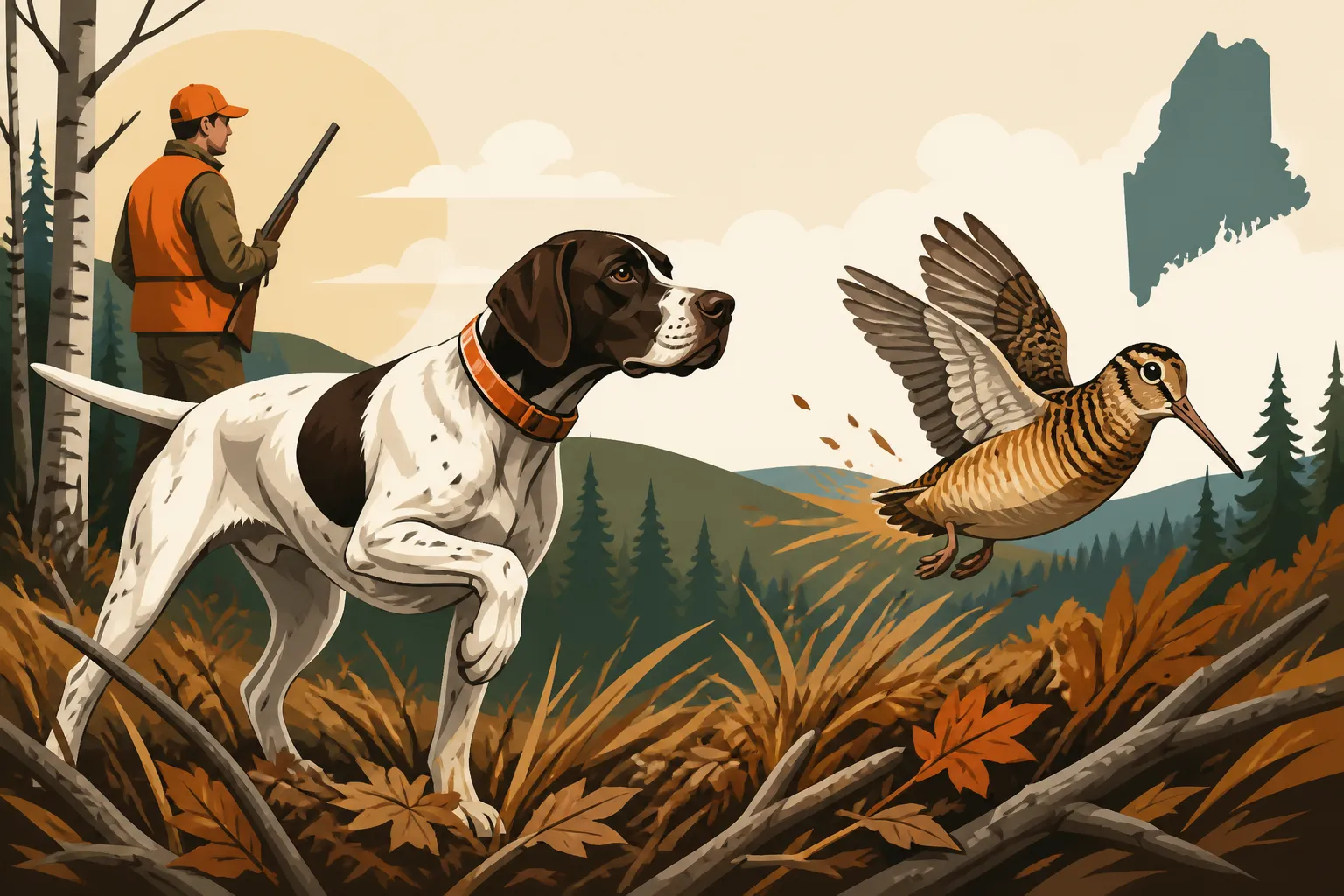
When your dog catches scent, it "points," freezing rigidly, nose aimed directly at the bird. This incredible instinct gives you, the hunter, crucial time to approach, prepare your shot, and flush the bird under controlled conditions. Without a dog, you're essentially kicking brush and hoping for the best, often flushing birds wild or getting only a fleeting glimpse. With a pointer, the encounter becomes a deliberate, exciting event, where strategy and teamwork come into play. It's about working with your dog, reading their body language, and trusting their nose to lead you to the prize. Plus, a good retriever can find downed birds in thick cover, preventing those heartbreaking losses that can happen when a bird falls into tangles of alders or briars.
The Thrill of the "Timberdoodle" Flush
Even after years of hunting, the sudden, explosive flush of a woodcock from beneath your feet never fails to get the heart pounding. When your pointing dog locks up, rigid as a statue, and you slowly walk in, every sense is heightened. You know the bird is there, hidden in the tangle, just waiting. The air is thick with anticipation. Then, with a burst of wings and a distinctive whistling sound, the woodcock explodes upwards, often twisting and turning through the branches before settling into a predictable, short flight path. This moment, orchestrated by your dog's keen senses and your patient approach, is the essence of upland hunting.
Compare this to the often frustrating experience of blindly stumbling through cover, hoping to kick up a bird. With a dog, you're not just hoping; you're expecting the flush, allowing you to mentally prepare for the shot. This makes for a more ethical hunt, as you're less likely to take hurried, unsafe shots, and more likely to make a clean kill. The satisfaction of connecting with a bird that your dog precisely located is unparalleled. It's a true partnership, a dance between human and animal that elevates the hunt beyond merely harvesting game.
Developing an Unbreakable Bond Through the Hunt
Hunting with a pointing dog is about far more than just filling a game vest; it's about forging a deep, reciprocal bond. You rely on your dog's instincts and training, and your dog relies on your leadership and trust. Every successful point, every retrieved bird, every shared moment in the field strengthens that connection. Your dog learns to read your movements, anticipating where you'll walk in, and you learn to interpret their subtle cues – the twitch of a tail, the intensity of a gaze – that tell you a bird is near.
This partnership extends beyond the hunt itself. The hours spent training, the shared adventures in the Maine woods, the mutual respect developed through working toward a common goal, all build a bond that enriches both your lives. A well-trained bird dog becomes an extension of yourself, and their success feels as much your own as their tireless effort. Many hunters feel that the presence of their dog elevates the entire experience, turning a solitary pursuit into a shared journey of discovery and connection with nature. It’s truly a privilege to witness a good dog work, and to be a part of that instinctual ballet.
Essential Training and Preparation for Your Upland Companion
Getting your pointing dog ready for Maine woodcock season isn't something that happens overnight. It requires patience, consistency, and a deep understanding of canine behavior. Just like you'd scout for prime Woodcock Hunting Maine Covert Country, you need to scout and prepare your dog.
Foundation Training: Steadiness, Recall, and Whistle Commands
Before you even think about introducing your dog to birds, you need a solid foundation of obedience. This means a rock-solid recall, where your dog comes back to you every single time, without hesitation, regardless of distractions. It also means steadiness to wing and shot, which is absolutely critical for safety and successful hunting. A dog that breaks point or chases a flushing bird can be dangerous for you and other hunters, and can also ruin opportunities. Steadiness ensures your dog holds its point until you command it to flush or retrieve.
Whistle commands are invaluable in the field, especially when your dog is out of sight in thick Maine cover. A single "come" whistle or "whoa" command needs to be ingrained so deeply that it's an automatic response. Start training in distraction-free environments, gradually introducing more challenges, like other people, dogs, and eventually, the scent of birds. Consistency is key; every training session reinforces these vital commands. Think of it like learning the alphabet before you can write a novel – these are the fundamentals that make everything else possible.
Scent Work and Bird Introduction: Getting Them on Woodcock
Once the basic obedience is solid, you can start introducing your dog to bird scent. Many trainers begin with quail or pigeons, as they are readily available and easier to control. The goal is to develop your dog's natural prey drive and teach them to associate the scent with a "point." This can involve using pigeon wings on a string, scent posts, or planted birds. The real magic happens when you get your dog on wild birds, or at least birds that behave more naturally.
For woodcock, this often means taking your dog to known woodcock coverts even before the season opens, ensuring you're legally allowed to train there. In Maine, this often involves walking dogs through those dense Grouse Hunting Maine Alder Runs where woodcock also congregate. It allows your dog to encounter the unique scent of a woodcock, which differs from other game birds. Pay close attention to how your dog reacts; a slight change in gait, a sudden head snap, or an increased intensity in their tail wag can all indicate they're winding a bird. Positive reinforcement is crucial at every step – lavish praise and maybe even a small treat when they hold a good point. Remember, you're nurturing their instinct, not breaking their spirit.
Physical Conditioning for Maine's Tough Cover
Maine's woodcock cover is no walk in the park. It's often dense, wet, and can involve navigating blowdowns, beaver flowages, and thick brush. Your dog needs to be in peak physical condition to handle a full day of hunting without risking injury or exhaustion. Start their conditioning regime well before the season. This includes regular runs, long walks through varied terrain, and even swims if your dog enjoys water.
Just like an athlete, your dog needs to build stamina and muscle. Overweight or out-of-shape dogs are more prone to injuries, like torn pads or strained muscles, and will tire out quickly, diminishing their effectiveness and enjoyment. Also, consider protective gear like a blaze orange vest to keep them visible to you and other hunters, and protective booties if you're in particularly rocky or thorny areas. Regularly check their paws for cuts or thorns, and carry a basic first-aid kit designed for dogs. A tired dog isn't a happy or effective hunting companion, so prioritize their physical well-being. Using tools like the GoHunt app can also help you scout the terrain severity before you even get out there, allowing you to adjust your dog's conditioning as needed for different areas.
Navigating Maine's Prime Woodcock Coverts
Finding woodcock in Maine is a science and an art. These birds are migratory and follow specific patterns, making certain habitats irresistible to them at different times of the season. Knowing where to look is half the battle, and your pointing dog will do the other half.
Identifying Prime Alders, Young Birch, and Wet Bottomlands
Woodcock are moisture-loving birds, and their preferred diet of earthworms ties them directly to damp soil. This means you'll often find them in areas with rich, moist earth, typically associated with alders, young birch stands, and other dense, early successional cover. Think of swamp edges, river bottoms, and the fringes of beaver ponds. Look for areas with a thick overhead canopy to provide cover from raptors and open understory near the ground where they can easily probe for worms.
In Maine, these areas are abundant. When you're scouting, look for "woodcock sign" – their distinctive splashy droppings (often described as white and black paint splatters) and small, pencil-sized probing holes in the moist soil. These are clear indicators that birds are or have been present. Early in the season, you might find them in slightly drier, higher ground, but as the season progresses and the ground freezes, they'll gravitate towards areas that retain moisture longer. Knowing what to look for, coupled with your dog's nose, creates an unstoppable team. Remember to consider Maine Woodcock Singing Ground Surveys data if you want to find historically productive breeding areas, which can often be good fall hunting spots too.
Understanding Seasonal Woodcock Movement and Migration
Woodcock are migratory birds, passing through Maine on their journey south. This means that the best hunting spots can change throughout the season. Early season, you'll often find local birds that bred in Maine, typically scattered across suitable coverts. As October progresses into November, you'll start to see waves of migrating birds pushing down from Canada and northern Maine. This is when some of the most exciting hunting can occur, as large numbers of birds concentrate in specific staging areas before their final push south.
Monitoring weather patterns is crucial. A cold snap or the first hard frost up north can signal a new flight of birds moving into central or southern Maine. The timing of When Woodcock Migrate Through Maine is critical for planning your hunts. Focus on those prime, moist coverts that are easily accessible, as these will be magnets for transient birds. It’s also important to be aware of the Maine Small Game Season Rules and specific woodcock bag limits, as these can vary. Using resources like the GoHunt app to track weather and look at topographical maps can help predict these movements, pointing you toward prime migration corridors and stopover points.
Leveraging Tools to Scout and Navigate
Modern technology can significantly aid your woodcock hunting, especially when combined with a pointing dog. GPS devices or mapping apps like GoHunt are invaluable for marking hotspots, navigating dense cover, and ensuring you don't trespass onto private property. Before heading out, study aerial photos to identify likely looking coverts – those dense green patches along water sources or in old clear-cuts are often prime territory.
Beyond digital tools, a good old-fashioned compass and map are always wise backups, especially in remote areas. Knowing how to read the terrain, identify subtle changes in vegetation, and understand how water influences habitat will make you a more effective hunter. Don't forget to leverage the insights from the Scouting With the Maine Hunting App to find public access points and analyze land ownership. By combining your knowledge of woodcock behavior with mapping tools and your dog's phenomenal nose, you'll maximize your chances of finding birds, whether you're working the edges of a sprawling timber company tract or a small woodlot near home.
Strategies for a Successful Hunt with Your Pointing Dog
The actual hunt is where all your preparation and your dog's training culminate. It's a dynamic interplay between you, your dog, and the birds.
Working the Dog and Hunter Together in Thick Cover
Hunting woodcock in Maine's thick cover is often a slow, deliberate process. Your dog should work within gun range, typically 20-40 yards, allowing you to quickly get to a pointing dog before a bird decides to sneak out. This is where those whistle commands and steady training become paramount. In very dense cover, you might need to adjust your walking speed to keep up with your dog, or even encourage them to work closer. Communication is key; a short whistle or a hand signal can help direct your dog into a particularly birdy-looking patch.
When your dog goes on point, approach cautiously and deliberately. Scan the area where your dog is pointing. Woodcock often hold incredibly tight, sometimes not flushing until you're practically on top of them. Your goal is to position yourself for the best possible shot when the bird flushes, considering potential shooting lanes and safe backstops. In a thick alder tangle, this might mean circling slightly to get a clearer view or being ready for a quick, close shot. Remember, the woodcock's flight is usually short and straight up before a brief level flight, so be ready to mount your gun quickly.
Handling the Flush and the Shot Opportunity
The flush is the moment of truth. Once you're in position, walk past your dog, moving towards where they indicate the bird is located. Sometimes a gentle kick to the brush will get the bird airborne. The woodcock will typically rise vertically before darting away. This gives you a brief window to track the bird, swing through, and take your shot. Because woodcock are small and fast, and often flying through thick cover, quick reflexes and accurate shooting are essential.
If you miss, mark where the bird went down, as they often don't fly far. If you connect, great! Now it's your dog's time to shine with a retrieve. Ensure your dog is trained to retrieve to hand, bringing the bird directly back to you without mouthing or damaging it. This not only prevents lost birds but also reinforces the teamwork aspect of the hunt. If your dog is having trouble locating a downed bird in particularly dense cover, take a moment to breathe and let their nose do the work. Remember, the goal is a clean kill and a quick recovery. Sometimes, reading the soft ground for subtle signs can help, similar to how one might go about Reading Maine Mud for Fresh Deer Movement, but on a much smaller scale, looking for disturbance from a downed bird.
Post-Hunt Care for Your Hard-Working Dog
After a day of working hard in the Maine woods, your pointing dog deserves thorough care. Check their paws for cuts, thorns, or cracked pads. Inspect their ears for burrs or foxtails that might have worked their way in. Provide them with fresh water immediately and a good, high-quality meal to replenish their energy. If you've been in particularly cold or wet conditions, ensure they have a warm, dry place to rest.
Like any athlete, a hunting dog benefits from proper cool-down and recovery. A gentle massage can help ease tired muscles. Most importantly, give them plenty of praise and affection. They've worked tirelessly for you, relying on their instincts and training. A healthy, well-cared-for dog is a happy dog and a ready partner for the next adventure. This dedication to your dog's well-being is part of what makes hunting with a pointing dog such a rewarding experience, cementing that bond you share. This holistic approach ensures your dog remains an eager and capable hunting partner for many seasons to come.
| Dog Breed | Key Characteristics for Woodcock Hunting | Ideal Hunter Temperament |
|---|---|---|
| English Setter | Elegant, strong nose, wide range, excellent pointer, generally calm and biddable. Can cover a lot of ground. | Patient, enjoys long walks, appreciates classic style. |
| Brittany | Compact, energetic, excellent nose, typically works closer than Setters/Pointers, very intelligent and eager. | Active, likes a cooperative, close-working dog. |
| German Shorthaired Pointer | Versatile, strong nose, high energy, good retriever, can handle various game and terrain. Bold and confident. | Energetic, values versatility and robustness. |
| Pointer | Classic wide-ranging bird dog, incredible speed and endurance, powerful nose, intense point. | Demands stamina, loves a fast, wide-working dog. |
| Gordon Setter | Heavier, slower-working than English Setter, very methodical, strong nose, good in dense cover. Loyal and steady. | Deliberate, values thoroughness and steadfastness. |
| Small Munsterlander | Versatile, intelligent, works methodically, strong pointing and retrieving instincts, good close-working dog. | Patient, prefers a close-working, intelligent companion. |
Disclaimer
Hunting carries inherent risks, and it is the responsibility of each individual to understand and comply with all local, state, and federal hunting regulations. Always prioritize safety for yourself, your hunting partners, and your dog. Consult the Maine Department of Inland Fisheries and Wildlife for the most current rules and season dates. This content is for informational purposes only and does not constitute professional advice.