Hunting a Timber Company Access Road
Navigating the vast tracts of timber company land in Maine can feel like deciphering a secret code. Hunters often struggle with knowing where they can legally go, how to interpret the subtle signs of deer movement on these industrially managed landscapes, and how to effectively hunt without disturbing active operations. This guide will walk you through understanding timber company access, scouting effectively along their roads, and employing successful hunting strategies while respecting the unique environment of these working forests.
Understanding Timber Company Lands and Access Rules
Maine is unique in its vast expanse of privately owned timberlands, much of which is open to public recreational use, including hunting. However, this access isn't without its nuances and responsibilities. Many hunters initially get frustrated, thinking all private land is off-limits, but in Maine, a significant portion operates under a different set of unwritten, and sometimes written, rules.
The "Implied Permission" Tradition and its Limits
For generations, Maine has operated under an "implied permission" tradition, particularly across vast tracts of industrial forest land. This means that if the land isn't explicitly posted with "No Trespassing" signs, or if gates aren't locked, it's generally understood that the public has permission for recreational activities like hunting, fishing, and trapping. This is a huge benefit to hunters, offering access to millions of acres. However, this tradition comes with critical limits. It's not a free-for-all. Landowners can and do change their policies, and what's open one year might be gated or posted the next. You need to be diligent about confirming access. Utilizing resources like the Maine Department of Inland Fisheries and Wildlife (MDIFW) website or mapping apps like onX Hunt can be invaluable here. These tools often show property boundaries and sometimes even landowner contact information, helping you understand Maine's Private Land Access Tradition and avoid unintentional trespass. Always err on the side of caution: if there's any doubt, seek explicit permission or choose another spot.
Navigating Gate Systems and Fees
Many large timber companies, especially in the North Maine Woods region, manage access to their lands through gate systems. These gates are in place for various reasons, including controlling vehicle traffic, ensuring safety during logging operations, and funding road maintenance. While some gates are seasonal, others are staffed year-round, requiring a day-use or multi-day fee. This can sometimes catch hunters by surprise, adding an unexpected cost to their trip. It's crucial to research specific gate locations and their operating hours before you head out. Information on The North Maine Woods Gate System is readily available and will help you plan. Some companies might have specific rules about which roads are open to public vehicles, even within a gated system, so always inquire at the gatehouse. Respecting these systems, including posted speed limits and specific rules about ATV Rules on North Maine Woods Roads, is vital to maintaining the privilege of access. These fees often go back into maintaining the very road systems that allow you to reach prime hunting grounds, so view them as an investment in your hunting future.
Respecting Industrial Operations
Remember, timber company lands are working forests. This means you will encounter active logging operations, heavy machinery, log trucks, and associated personnel. Your safety, and theirs, is paramount. Never enter an active logging site, even if it's not explicitly blocked off. Loggers are often working in dangerous conditions, and your presence could put yourself or them at risk. Always yield to logging vehicles on roads; they are often heavy, fast-moving, and cannot stop quickly. During certain times of the year, particularly during mud season or after heavy rains, roads may be temporarily closed to prevent damage. Pay attention to all posted signs, road closures, and warnings. If you see activity, assume it's an active work zone and give it wide berth. Showing respect for these industrial operations goes a long way in ensuring these lands remain open to hunters for years to come.
Scouting and Interpreting Timber Road Sign
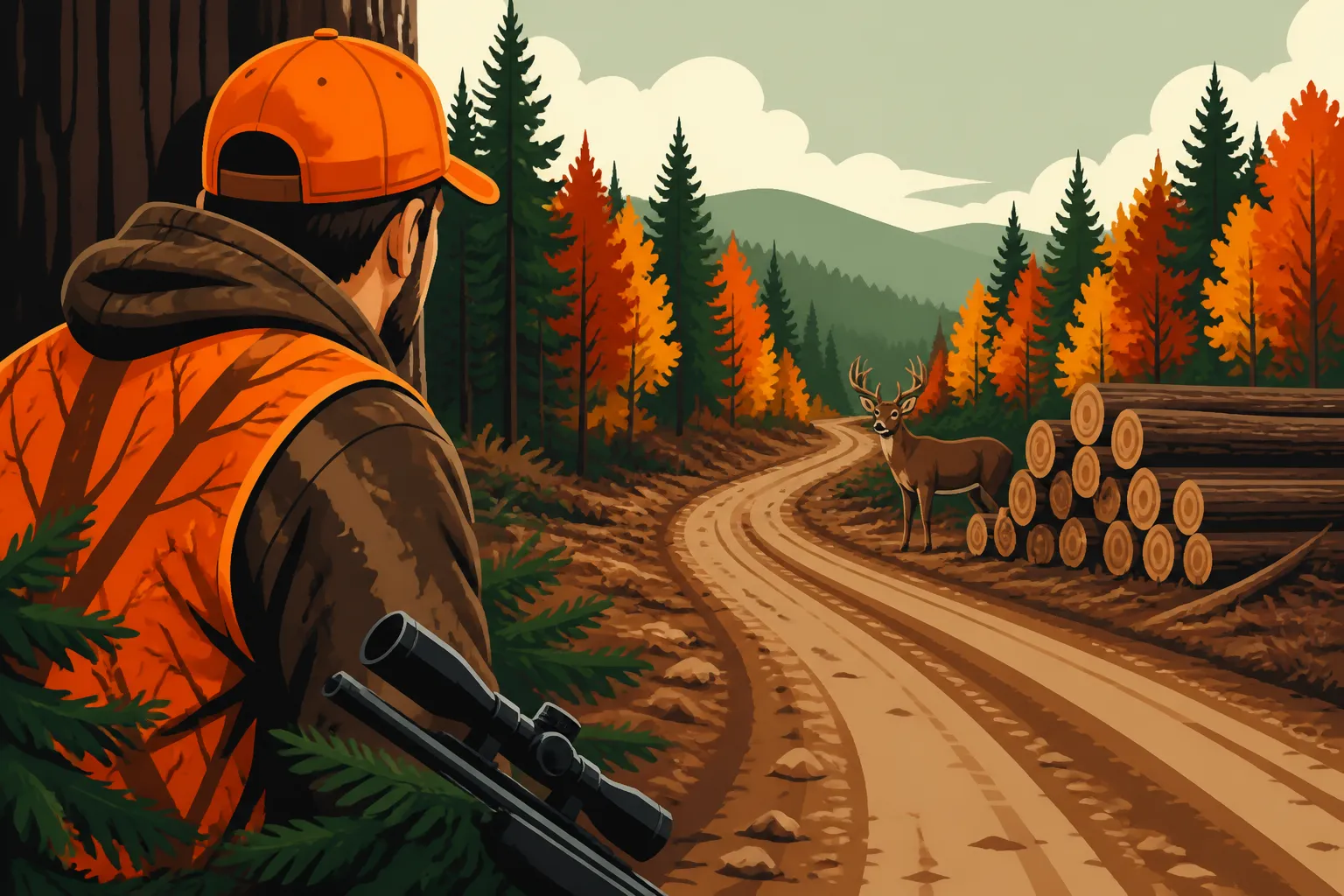
Timber company access roads, whether they're well-maintained gravel highways or barely-there two-tracks, are essentially linear features cutting through the forest. For savvy hunters, these aren't just pathways; they're prime scouting grounds and strategic hunting locations. Deer, moose, bear, and other game animals frequently use these roads, or the cover immediately adjacent to them, for travel, feeding, and security.
Using Mapping Apps for Reconnaissance
Before you even step foot in the woods, modern mapping applications are your best friend for scouting timber company land. Apps like onX Hunt allow you to overlay property lines, topo maps, and aerial imagery, giving you an incredible advantage. You can identify clear-cuts, young growth, mature timber stands, and potential pinch points or funnels that might be miles from the nearest paved road. By using the app's layers, you can discern different timber types, age classes of forest, and even where recent logging has occurred, which often creates excellent browse for deer. Scouting With the Maine Hunting App and similar tools helps you visualize the terrain and potential game movement before you ever burn a drop of gas driving down a logging road. Look for areas where different cover types meet, or where the terrain creates natural travel corridors. Even simple features like stream crossings or small hills along a road can be natural draws for game. You can use these insights to plan your approach and identify potential stand locations or still-hunting routes.
Identifying Deer and Other Game Movement Patterns
Timber roads, especially those less traveled, act like highways for wildlife. Deer will often walk roads, particularly at dawn and dusk, because it's easier than pushing through thick underbrush. Look for tracks, scat, and fresh rubs or scrapes along the road edges. Pay close attention to where tracks enter and exit the road, as these points often indicate travel corridors to bedding areas or feeding zones. A well-worn trail crossing a road, or a clear path through the brush leading to a logging landing, can be a major clue. You might find Scrape Lines Along a Logging Road during the rut, indicating a buck's regular patrol. Additionally, roads provide easy access to different habitats. For instance, a road might connect a dense spruce thicket (bedding cover) to a clear-cut with young hardwoods (feeding area). By identifying these connections, you can predict where and when deer will cross or travel along the road. Don't just look on the road; look into the timber edge and the clearings adjacent to it.
Finding Productive Habitat Along Roads
Timber management creates a mosaic of habitats, and access roads cut directly through these varied landscapes. Focus your scouting on areas where the road intersects or parallels different types of cover. Look for the edges of recent clear-cuts, where new growth provides abundant food. These areas, particularly where they meet mature timber, are magnets for deer seeking both browse and security. Hunting a Clear-Cut Regrowth Edge can be incredibly productive. Roads often follow natural contours, leading to creek bottoms, swamp edges, or saddles between ridges—all prime spots for deer movement. Also, keep an eye out for old apple trees or oak stands that might have been left during logging operations. These can be incredible late-season food sources that deer will seek out. Gravel pits, often found along timber roads, can also hold deer that are seeking minerals or using the disturbed ground for bedding. Pay attention to pockets of unlogged mature timber, which can serve as critical bedding cover or thermal protection during harsh weather.
Hunting Strategies for Timber Company Access Roads
Hunting timber company access roads isn't about sitting on the road, but rather using the road and the disturbed areas around it as a strategic element in your hunt. The key is to understand how game uses these linear features and to position yourself accordingly.
Still-Hunting the Edges and Clear-Cuts
Still-hunting is perhaps one of the most effective strategies when dealing with timber roads. Instead of staying on the road, slowly work your way along its edges, constantly scanning the woods and clear-cuts. Many hunters make the mistake of walking too fast or too loudly down the middle of the road. Instead, parallel the road, staying just inside the timber edge where your silhouette is broken up. This allows you to spot deer moving towards or away from the road, or even bedded nearby. Focus on pockets of thick cover, old logging landings, or dense regenerating clear-cuts. Move slowly, taking one to two steps, then stopping for several minutes to glass and listen. Deer often move parallel to roads, just inside the security of the trees. Still-Hunting Aroostook County Farmland shares a similar principle of using linear features and edges. Be mindful of your scent and the wind direction, always trying to keep it in your favor.
Setting Up for Intercepts
Timber roads create natural funnels and crossings. Identify these key intercept points through your scouting. A saddle that crosses a road, a narrow strip of timber between two clear-cuts, or a beaver dam crossing a stream that the road also crosses are all excellent spots for a stand or ground blind. Deer are creatures of habit and will often use the easiest path. Setting up on a point where they are likely to cross or travel along the road allows you to intercept them. Consider areas where the road offers a clear line of sight into a feeding area or a bedding area, but position yourself off the road, hidden from view. A well-placed stand overlooking a frequently used road crossing, especially during the rut when bucks are actively cruising, can be incredibly productive. Remember, road edges are often where you'll find fresh sign, making them ideal places to focus your setup.
Considering Wind and Thermals
Just like anywhere else in the woods, understanding wind and thermals is absolutely critical when hunting timber company access roads. Roads often create slight elevation changes and open corridors that can affect air currents. In hilly or mountainous timberland, thermals will typically rise in the morning as the sun warms the earth and fall in the evening as it cools. This means your scent will be carried uphill in the morning and downhill in the evening. When hunting roads, always be aware of how the wind will carry your scent, especially if you're overlooking a clear-cut or a bottomland. Positioning yourself to have the wind in your face, or at least quartering, as deer approach is essential. A slight breeze can carry your scent hundreds of yards down an open road. Always keep the wind in mind when planning your approach to a stand or deciding which way to still-hunt. Wind and Thermals in Maine Hill Country offers more insight into these vital atmospheric elements.
Safety and Ethics on Timber Company Lands
Hunting on timber company lands is a privilege, not a right. Our continued access depends on every hunter acting responsibly, safely, and ethically. Negligence or disrespect can lead to more posted land and restricted access for everyone.
Communicating Your Presence
Safety is paramount, especially when sharing the woods with industrial operations and other hunters. Always wear sufficient blaze orange, as required by Maine Blaze Orange Requirements, even when just scouting. Make noise as you walk, particularly if you're still-hunting in thick cover where visibility is limited. Consider carrying a whistle or other signaling device. If you encounter loggers or other workers, make your presence known from a safe distance, wave, and politely ask if it's safe to pass or if there are any areas to avoid. Many active timber roads see a lot of traffic from other hunters, hikers, and ATV riders, so always assume other people are in the vicinity. Being aware and communicative helps prevent accidents and fosters a positive image for hunters.
Minimizing Your Impact
Leave no trace. Pack out everything you pack in, and if you see any trash, consider packing that out too. Avoid driving off established roads, as this can damage sensitive habitat, compact soil, and create new, unauthorized trails. If you are using a tree stand, ensure it is clearly marked with your name and contact information and remove it at the end of the season, or according to specific landowner rules if provided. Do not cut trees or limbs unnecessarily, even for shooting lanes, without explicit permission. Respect any designated parking areas or temporary closures. The goal is to leave the land as you found it, or better. This responsible behavior is critical for maintaining the "implied permission" that hunters currently enjoy on much of Maine's private timberland. Remember, what you do reflects on all of us, and upholding good ethics is the best way to ensure future access.
Dealing with Active Logging Operations
Encountering active logging operations is a distinct possibility on timber company lands. If you come across a "No Entry" or "Active Logging" sign, or hear the distinct sounds of chainsaws and heavy machinery, do not proceed. Turn around and find an alternative route or hunting location. Never try to sneak around or through an active site; it is incredibly dangerous. Logs can roll unexpectedly, trees can fall, and heavy machinery has huge blind spots. The noise of equipment can also mask your presence, making it impossible for operators to see or hear you. If you've been dropped off in an area that later becomes active, use extreme caution and signal for attention from a safe distance before attempting to cross or exit. Timber companies prioritize safety, and cooperating with their operations helps them keep these lands open to the public without undue risk.
Here's a quick reference for common signs you might see on timber company roads:
| Sign Type | What it Means | Hunter Action |
|---|---|---|
| "No Trespassing" | Explicitly closed to public access. | Do not enter. Find alternative access. |
| "No Motor Vehicles" | Road closed to all vehicles, but foot traffic/ATVs may be allowed. | Park outside the gate or marked area. Proceed on foot or with approved ATV. |
| "Active Logging" | Logging operations are underway. | Turn around and avoid the area entirely. Danger of falling trees/heavy equipment. |
| "Road Closed – Mud" | Road is temporarily impassable or susceptible to damage. | Do not drive on the road. This preserves the road for future use. |
| "Gate Closed" | Access may require a key, permit, or fee, or be entirely closed. | Check for contact info, gatehouse hours, or information on The North Maine Woods Gate System. |
| "Walk-In Only" | Vehicles prohibited beyond this point. | Park and proceed on foot. Ideal for finding areas with less pressure. |
By understanding these signs and responsibilities, you can have a safe and successful hunt on Maine's invaluable timber company lands.
Disclaimer
This article is for general informational purposes only and does not constitute professional advice. Laws, prices and regulations vary by location and change over time. Consult a qualified professional for guidance on your specific situation.